‘Young Washington’ Brings George Washington’s Formative Years to Life at Mount Vernon Premiere
Exclusive Mount Vernon screening previews a July 4 nationwide release that follows George Washington's early struggles, failures, and rise to leadership.

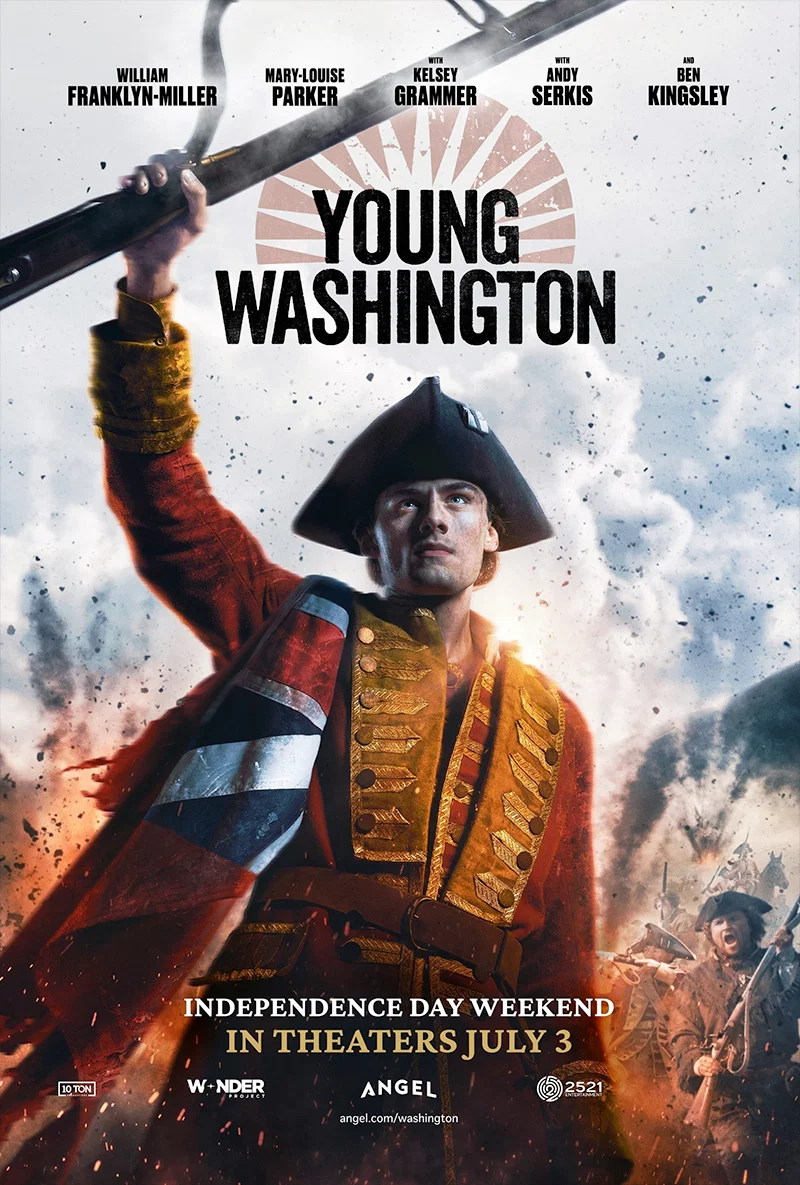
MOUNT VERNON, VA – Enter center frame: a very young, weeping George Washington, a boy who has just lost his father. A concerned older stepbrother, working his inherited land, teams up with George’s widowed mother to offer solace and pragmatism in one sweep. Our young hero’s response is to grab his schoolbooks and walk two miles to his schoolhouse, where his older brother Lawrence had warned him he would not be able to continue attending. The first, abstractly relatable, challenge of the hero’s journey is set.
Clearly, a classical version of the hero’s journey is launched in the tender scene. What follows is young George’s film version of “integrity, resilience, service, and America’s founding.” Along the way, viewers are often reminded of the teachable lessons of failure. Yes, failure on several fronts arises.
According to the film’s director, Jon Erwin, who appeared at an exclusive premiere at Mount Vernon on June 26, along with William Franklyn-Miller, who stars as young George Washington, the film’s intention is “to champion America’s story.”
“The American story is important,” Erwin said. “And it is missing in entertainment right now.”
The film—set for a nationwide July 4 release in theaters—is billed as “the untold story” of a young George seeking a position on a surveying expedition for the Fairfax family, using the education he had received in childhood, along with his own self-education, strong math and reading skills, and his newly earned surveyor’s license for the newly formed Culpeper County. At 17, he earned his first respectable career and self-earned confidence.
The youthful George then persistently lobbied for Lt. Gov. Dinwiddie’s appointment as an adjunct military officer, following in the footsteps of his stepbrother Lawrence. In 1753, he received an appointment in Virginia’s colonial military for the colony’s southern district, stretching to the boundary of North Carolina. In the film, scenes unfold of young George traveling through deep woods, meeting Native warriors who befriended him, and thoughtfully journaling his discoveries—all of which culminate in the story of his formative character.
While immersed in mounting military complications—including serving as a British emissary to urge the French to leave the Ohio Valley—Washington’s journal of his early experiences created a sensation as one of the first accounts of its kind, circulating as far as London. But soon, the story returns to the reality of young Washington and his expedition, which finds itself under attack by the French, resulting in severe losses for George’s troops and fellow Virginia colonials.
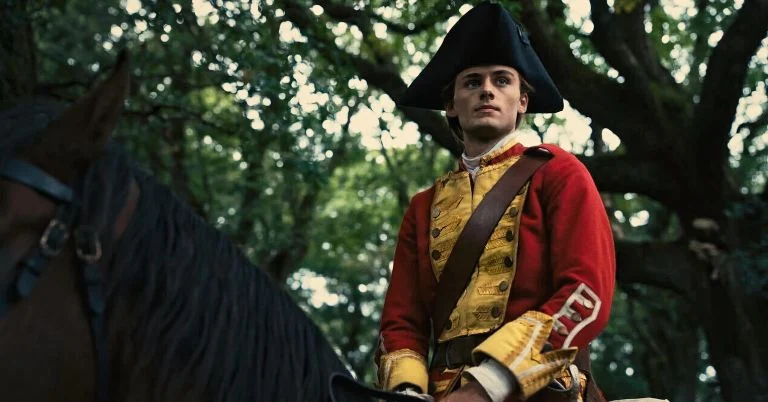
A sense of failure creeps into scenes of escalating fighting—French snipers, muddy plains and trails—and the young leader’s inexperience in battle heightens audiences’ fears and tensions. Suddenly, viewers find themselves rooting for the young surveyor and newly appointed Major Washington, who somehow survives with only bullet holes through his three-cornered hat.
With a significant amount of current hand-wringing over whether patriotism is threatened or democracy is on the wane, Young Washington provides a measure of ballast and, most definitely, America’s version of the hero’s journey—with loss, valor, unexpected mentors, and even moments that seem almost surreal. In one such moment, Major General Edward Braddock, commander in chief of the British forces in North America, relinquishes his red military sash to Washington. The film portrays this iconic relic as it passes into the hands of the young hero. Braddock’s sash is a protected artifact displayed at Mount Vernon and was exhibited under glass at the premiere.
Produced by a consortium of organizations, including Stand Together, Wonder Project, Angel, the Bill of Rights Institute, and George Washington’s Mount Vernon, Young Washington breaks new ground in a multitude of ways, including being featured and promoted on TikTok, according to the hopeful producers.
The much-anticipated film is also the centerpiece of a new civics education initiative using film to help students engage with history, leadership, and the founding principles of the Declaration of Independence. The screening spotlighted a broader classroom initiative led by the Bill of Rights Institute alongside Stand Together, an impact partner to Wonder Project and Angel. The effort will bring Young Washington into schools nationwide through free lesson plans, discussion guides, educator screenings, and a digital resource hub reaching more than 90,000 educators, as well as microschool and homeschool communities.
“I think a lot of the history we see of George Washington is in his later years, during his presidency. This film gives a unique perspective on his life we haven’t seen,” said Jeff Scandling, a resident of Alexandria who attended with his friend Danielle Hines.

Mount Vernon President & CEO Douglas Bradburn hosted a brief post-film discussion with Erwin and Franklyn-Miller, during which Bradburn presented them with gift bags containing Washington’s Rules of Civility and wood pens fashioned from timber from the Mount Vernon estate.
In closing the evening, Erwin noted award-winning director Ken Burns’ idea of “emotional archaeology” in the reconstruction of historic events, sharing a final wish:
“My hope is that this movie will be the beginning of the journey.”