
Why Alexandria Isn’t Part of Washington, D.C.—The Surprising Story Behind July 9, 1846
The Date Marks One of the Most Pivotal—and Complex—Moments in Alexandria's History

ALEXANDRIA, VA – Have you ever wondered why Alexandria is part of Virginia instead of Washington, D.C.?
Every year, July 9 quietly passes on the calendar, but for Alexandria it marks one of the most significant dates in the city’s history. On July 9, 1846, Congress approved legislation allowing the City of Alexandria and Alexandria County to leave the District of Columbia and return to the Commonwealth of Virginia—a process known as retrocession.
The decision permanently changed Alexandria’s future and remains one of the defining moments in the city’s history.
As Alexandria celebrates its 277th anniversary and America prepares for its 250th birthday, July 9 offers an opportunity to reflect on the city’s remarkable past—and the complicated political, economic, and moral forces that reshaped it nearly 180 years ago. Maybe it should be its own city holiday.
From Virginia to the Nation’s Capital
Alexandria became part of the nation’s capital in 1791, when Virginia ceded land along the Potomac River to help create the new federal district envisioned by President George Washington and authorized by the Residence Act of 1790.
To establish the boundaries of the new District of Columbia, surveyor Major Andrew Ellicott, assisted by free Black astronomer and mathematician Benjamin Banneker, laid the first boundary marker at Jones Point. Although the original stone was later replaced in 1794, that boundary stone still stands today beside the Jones Point Lighthouse and is considered one of the nation’s oldest surviving federal monuments.
At the time, Alexandria’s leaders believed joining the federal district would strengthen the city’s economy and make its thriving port an important center of the new national government.
For a while, that seemed possible.
Expectations Give Way to Frustration
Those early hopes gradually faded.
According to Alexandria’s Office of Historic Alexandria, Congress concentrated nearly all major federal development—including the Capitol and the President’s House—on the Maryland side of the Potomac River. Alexandria remained part of the federal district but received little of the investment many residents had expected.
Meanwhile, Alexandrians lost an important part of their political voice. As residents of the District of Columbia, they no longer voted for members of Congress or for president, yet Congress exercised complete authority over local affairs.
Economic conditions also worsened. Following the War of 1812, Alexandria’s once-busy port struggled to compete with rapidly growing cities such as Baltimore, while the Panic of 1837 further damaged the local economy. Many merchants and civic leaders began arguing that the city would be better served by returning to Virginia.
A Complicated History
Economic decline and the lack of political representation were not the only forces behind retrocession.
By the 1830s, Alexandria had become one of the nation’s largest centers for the domestic slave trade. The Franklin & Armfield slave-trading firm operated from Duke Street, where thousands of enslaved men, women, and children were imprisoned before being shipped to markets across the Deep South.
Many influential white Alexandrians feared Congress might eventually abolish slavery or the slave trade within the District of Columbia. Returning to Virginia was viewed by many supporters as a way to protect those economic interests.
Modern historians generally agree there was no single reason Alexandria sought retrocession. Instead, economic frustration, political disenfranchisement, and the desire among many local leaders to preserve slavery all contributed to the movement. While historians continue to debate the relative importance of each factor, all are now recognized as significant parts of the story.
Congress Approves Retrocession
On July 9, 1846, Congress passed legislation authorizing the return of Alexandria and Alexandria County to Virginia.
The proposal then went before Alexandria voters in a local referendum held Sept. 1 and 2, 1846.
The results were decisive:
- 763 votes in favor
- 222 votes opposed
Only white men were permitted to vote. Alexandria’s free Black residents had no voice in the decision, even though the outcome would dramatically affect their lives. After retrocession, Virginia’s laws imposed stricter legal restrictions on free Black residents than those that had existed while Alexandria remained part of the District of Columbia.
On Sept. 7, 1846, President James K. Polk officially proclaimed the retrocession complete. Virginia formally accepted the land back into the Commonwealth in March 1847 with speeches, cannon salutes, parades, and public celebrations.
Alexandria had been part of the District of Columbia for 55 years.
Places Where You Can Still See This History

Jones Point Park
Perhaps no place tells the story of Alexandria’s unique history better than Jones Point Park.
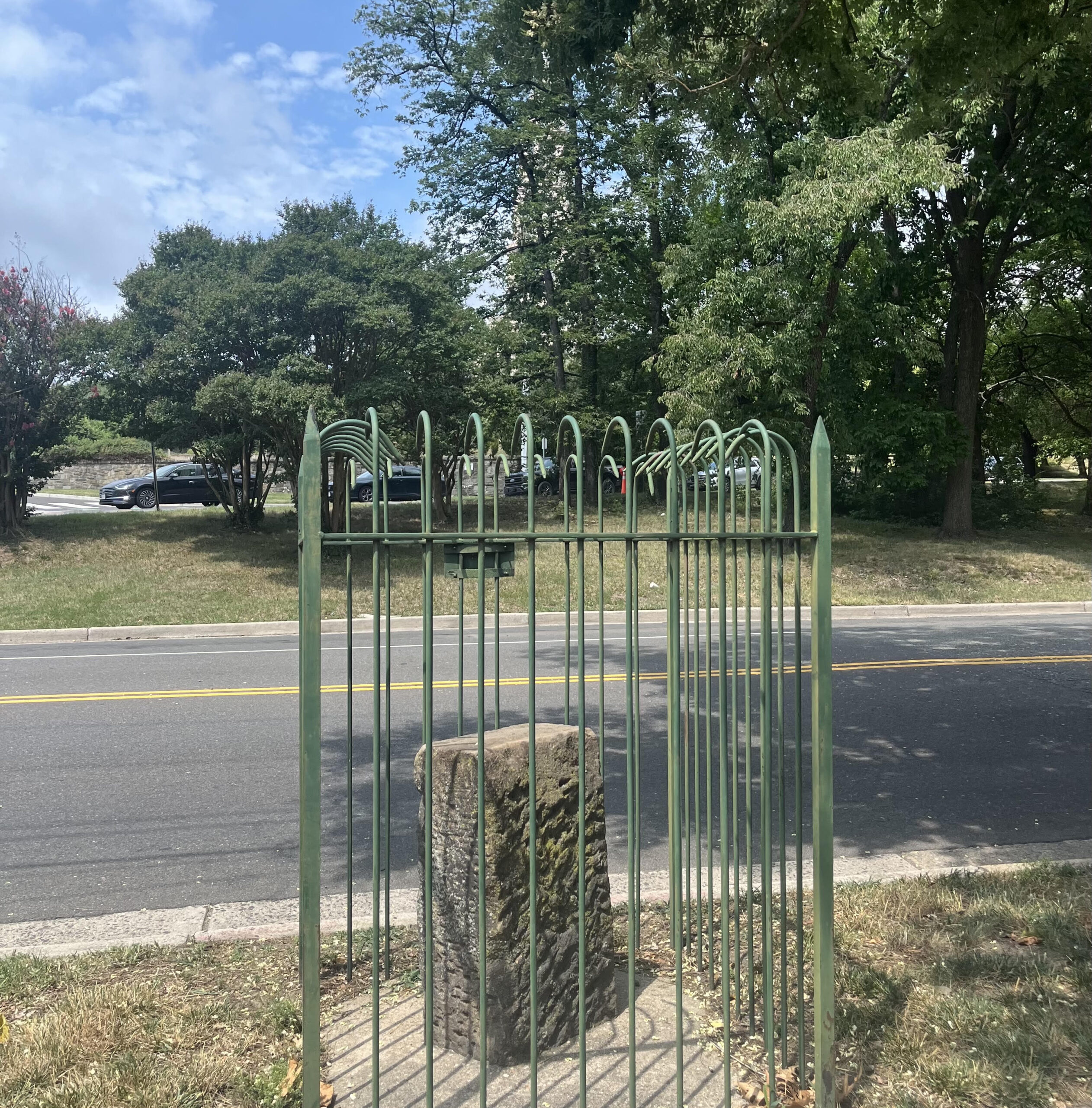
The park is home to the original southern boundary marker of the District of Columbia. Visitors can still see the 1794 boundary stone near the Jones Point Lighthouse, marking the southern point of the original federal district. It remains one of the oldest surviving federal monuments in the United States and serves as a physical reminder that Alexandria was once part of Washington, D.C.
Freedom House Museum
Located at 1315 Duke Street, the Freedom House Museum preserves one of the country’s most important sites connected to the domestic slave trade. The museum tells the stories of thousands of enslaved people forced through Alexandria before being sold farther south, providing important context for understanding one of the motivations behind retrocession.
District Boundary Stones
Alexandria is also home to several of the original sandstone boundary markers placed around the federal district beginning in 1791. Many still stand today, making them among the oldest federal monuments in the country and tangible reminders of Alexandria’s years as part of Washington, D.C.
Why July 9 Still Matters
July 9 represents far more than a change on a map.
It marks the moment Alexandria chose a different future—one shaped by hopes for economic renewal, frustration over political representation, and the difficult reality that slavery influenced many of the decisions made by those in power.
Nearly 180 years later, that decision still shapes everyday life. Alexandrians vote in Virginia elections, live under Virginia law, and often identify first as Virginians rather than Washingtonians. Yet reminders of the city’s years inside the nation’s capital remain all around us, from the boundary stones at Jones Point to the streets that once formed part of the original federal district.
Remembering July 9 means embracing Alexandria’s full story—the inspiring chapters, the difficult truths, and the remarkable journey of a city that helped build the nation’s capital before ultimately returning home to Virginia.