A Special Elephant Brings a Global Story to Nepenthe Gallery’s New Fort Hunt Road Space
JAI, a life-size elephant sculpture from The Great Elephant Migration, is now on view — and for sale — at Nepenthe Gallery’s brighter, larger Hollin Hall home.

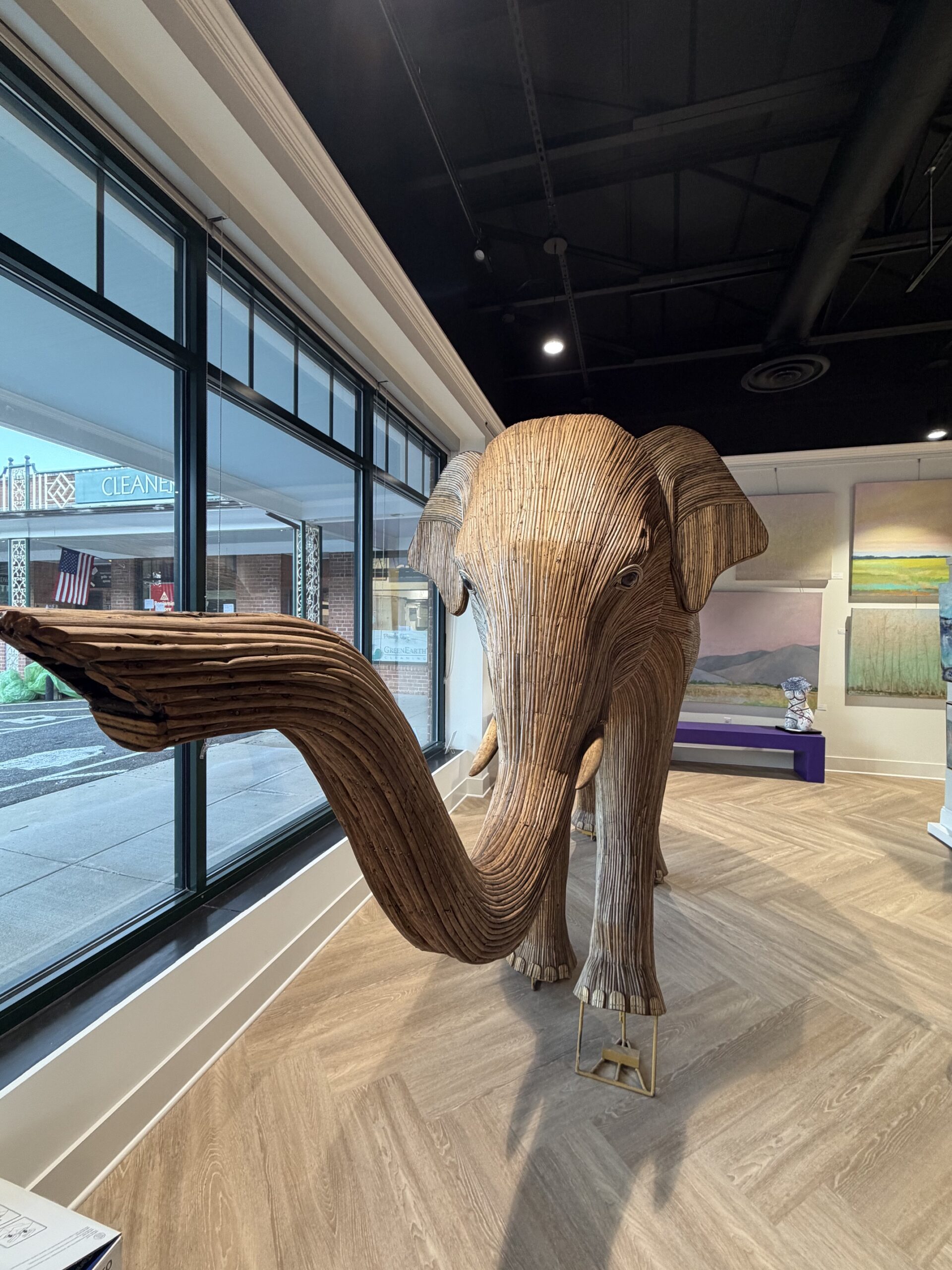
ALEXANDRIA, VA – There is, quite literally, an elephant in the room at Nepenthe Gallery’s new home in the Hollin Hall Shopping Center.
He is hard to miss.
His name is JAI — pronounced “Jay” — and the life-size adolescent elephant sculpture now stands in one of the gallery’s enormous front windows at 7928 Fort Hunt Road.
Made by Indigenous artisans in southern India from the invasive plant Lantana camara, JAI is one of 100 sculptures created for The Great Elephant Migration, a traveling art and conservation project centered on the coexistence of people and wild elephants.
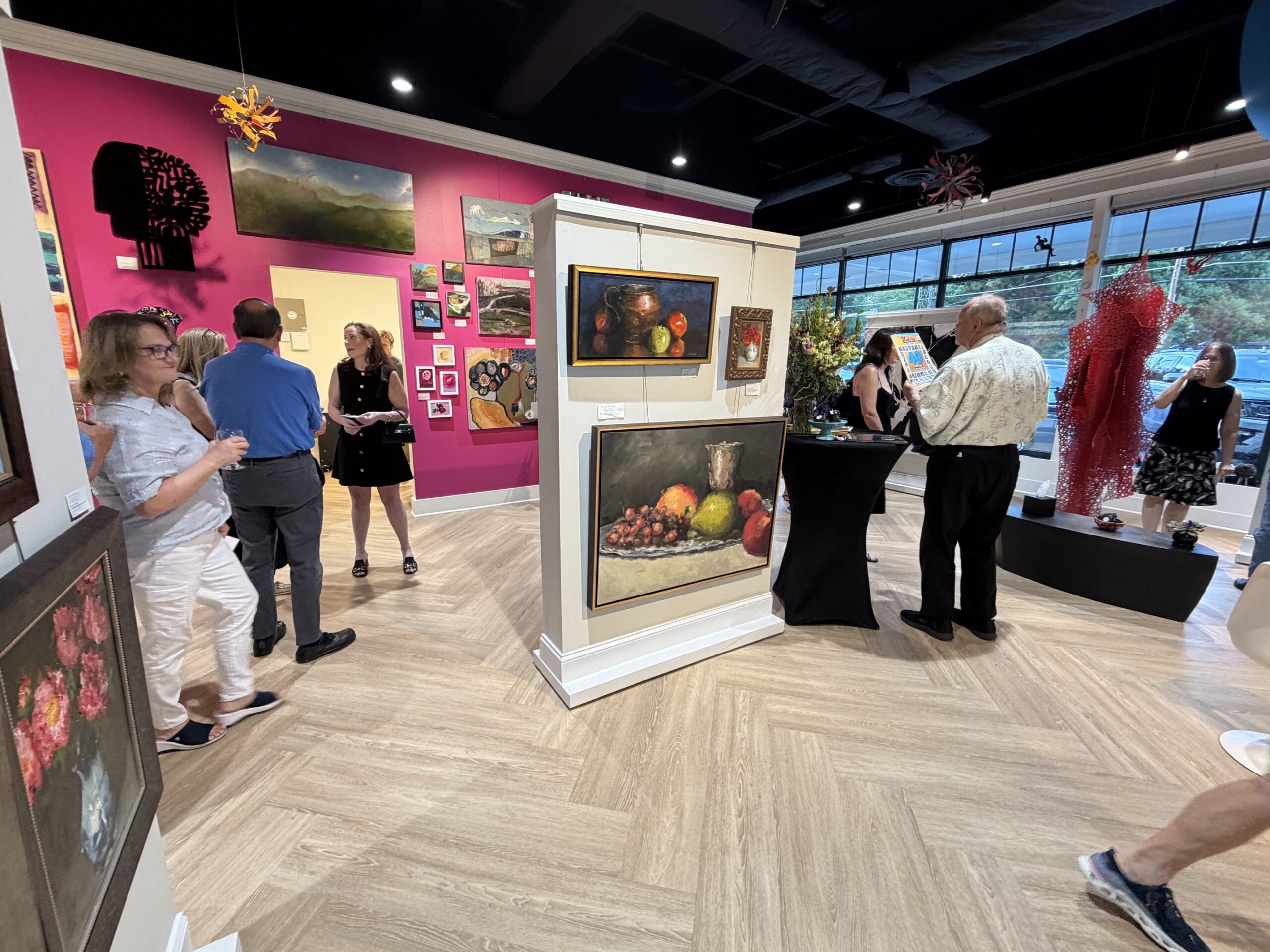
JAI was the centerpiece of Nepenthe’s Aug. 6 reopening celebration, as visitors filled the gallery’s larger, lighter new setting in the former Wells Fargo space.
A New Home, Just Steps Away
Carrie and Jim Garland opened Nepenthe Gallery and its frame shop in 2022 at 7918 Fort Hunt Road, tucked behind the pastry shop in Hollin Hall Shopping Center. They did not close during the move; instead, they relocated to the prominent corner storefront nearby, which offers windows facing both Fort Hunt and Shenandoah roads.
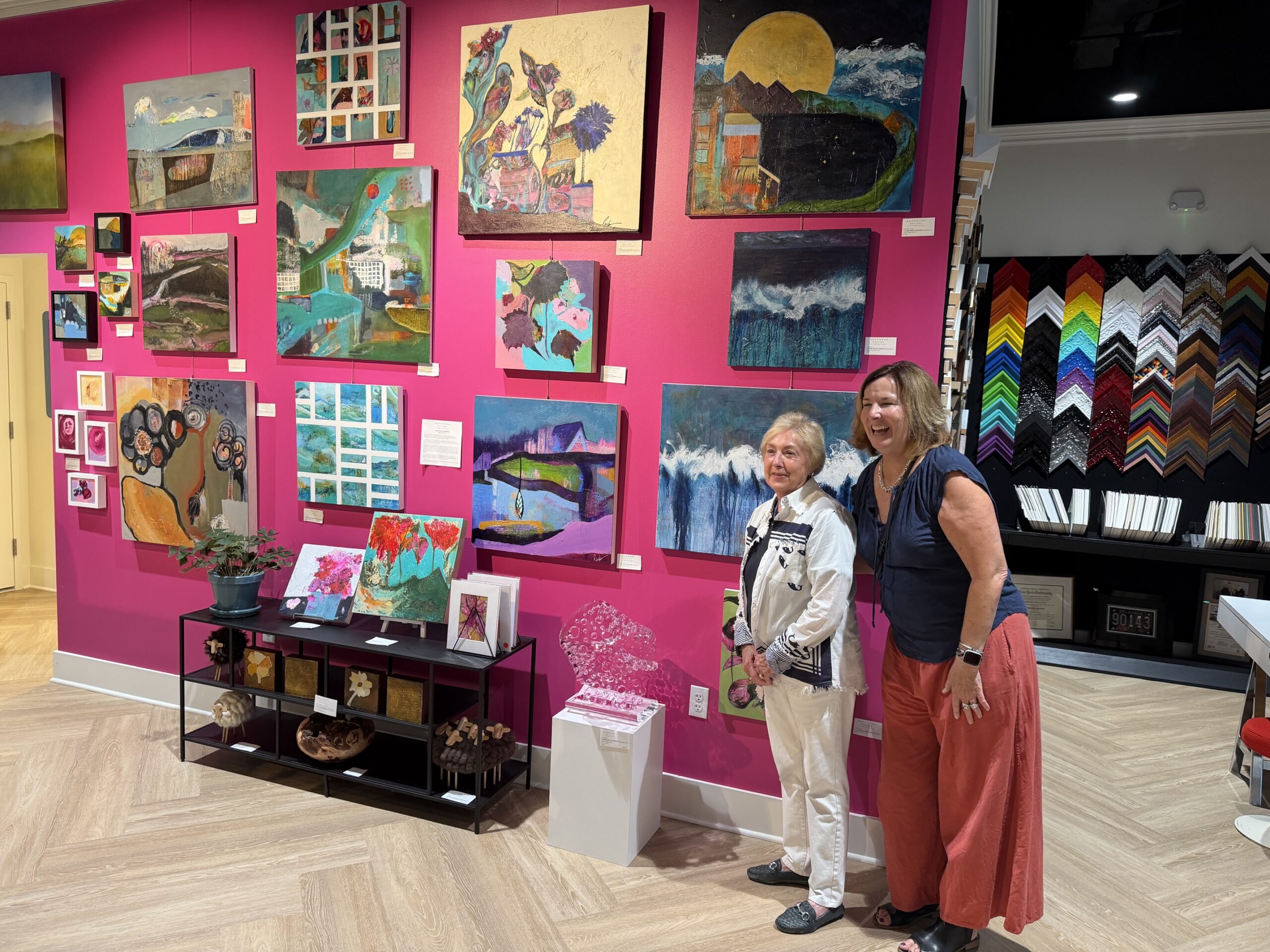
Formerly a Wells Fargo Bank branch, the new space is about 30 percent larger, with more natural light and movable exhibition walls that allow the Garlands to feature more art and sculpture. Jim Garland oversees the framing operation, while Carrie Garland manages the gallery’s exhibitions and community events.
“This will give us more visibility,” Carrie Garland told the Mount Vernon Gazette before the move, imagining art displayed in the three large windows facing Fort Hunt Road.
The expanded space is also home to Nepenthe’s new exhibition of plein-air landscapes and still lifes by Alexandria artist Kim T. Richards.
Garland told the Gazette she and Jim chose the neighborhood because they wanted to operate a community business close to home. “I like being in the fabric of the community,” she said. “This is a community that appreciates art.”
From Li Doo Mooh to JAI
Nepenthe’s first elephant from The Great Elephant Migration was Li Doo Mooh, JAI’s sister. Garland purchased Li Doo Mooh in California after the project’s Los Angeles presentation and installed her in Nepenthe’s pop-up sculpture garden at the American Horticultural Society’s River Farm, which The Zebra covered in October 2025.
“It has been such a joy to create this special exhibit,” Garland said at the time. “Sculpture is such a dynamic medium and brings boundless energy to a space. Honestly, this experience has been exhilarating!”
The River Farm installation was originally planned as a one-month exhibit. Instead, it has grown into an ongoing partnership between Nepenthe and River Farm/American Horticultural Society. Sculptures from Nepenthe remain on view there, are available for purchase, and will be rotated periodically.
Li Doo Mooh has since been sold to Brookgreen Gardens in Murrells Inlet, South Carolina, where she now lives among thousands of other sculptures.
Wanting to open the new space with another elephant, the Garlands purchased JAI in New York City before the herd migrated to Boston. The choice had a family symmetry: the Garlands acquired Li Doo Mooh in California, where one daughter lives, and found JAI in New York, where another daughter lives.
“We wanted to open in the new space with another elephant because they are so awesome!” Garland said.
JAI is available for purchase through Nepenthe Gallery for $25,000.
Every Elephant Began With a Real One
JAI is one of just 100 sculptures created for The Great Elephant Migration, a traveling art and conservation project focused on the coexistence of people and wild elephants.
Each sculpture is modeled after an actual wild Asian elephant from the Nilgiri Hills of southern India.
“Every sculpture begins with a real elephant,” the project explains.
In the Nilgiri region, Indigenous communities live near one of the largest remaining populations of Asian elephants. The animals are known individually by the people who share their landscape — their personalities, habits and movements observed as they pass among forests, farms, villages and towns.
The sculptures are not generic elephants. Each represents a particular animal from a living herd.
They are made by The Real Elephant Collective, an Indigenous-led group of artisans from the Bettakurumba, Paniya, Kattunayakan and Soliga communities of the Nilgiri Biosphere Reserve.
Artisans shape each elephant’s wire structure and weave it with Lantana camara, an invasive plant that threatens habitat used by real elephants. By harvesting the plant and turning it into sculpture, the makers create an economic opportunity from an environmental problem.
“Every elephant carries the fingerprints of its makers,” The Great Elephant Migration says.
For now, JAI stands watch in Nepenthe’s new window, bringing a global conservation story — and a very large new presence — to Fort Hunt Road.
IF YOU GO
What: See JAI, one of 100 life-size elephant sculptures from The Great Elephant Migration, at Nepenthe Gallery.
Where: Nepenthe Gallery
7928 Fort Hunt Road
Alexandria, VA 22308
Hours: Tuesday–Friday, 11 a.m.–6 p.m.; Saturday–Sunday, 9 a.m.–4 p.m.; and by appointment.
Phone: 571-347-7961
Website: nepenthegallery.com
Learn More: The Great Elephant Migration