
Rare Blue Frog Becomes Alexandria’s Newest Celebrity
The unusually colored green tree frog nicknamed “Bluey” is captivating visitors at Huntley Meadows Park.
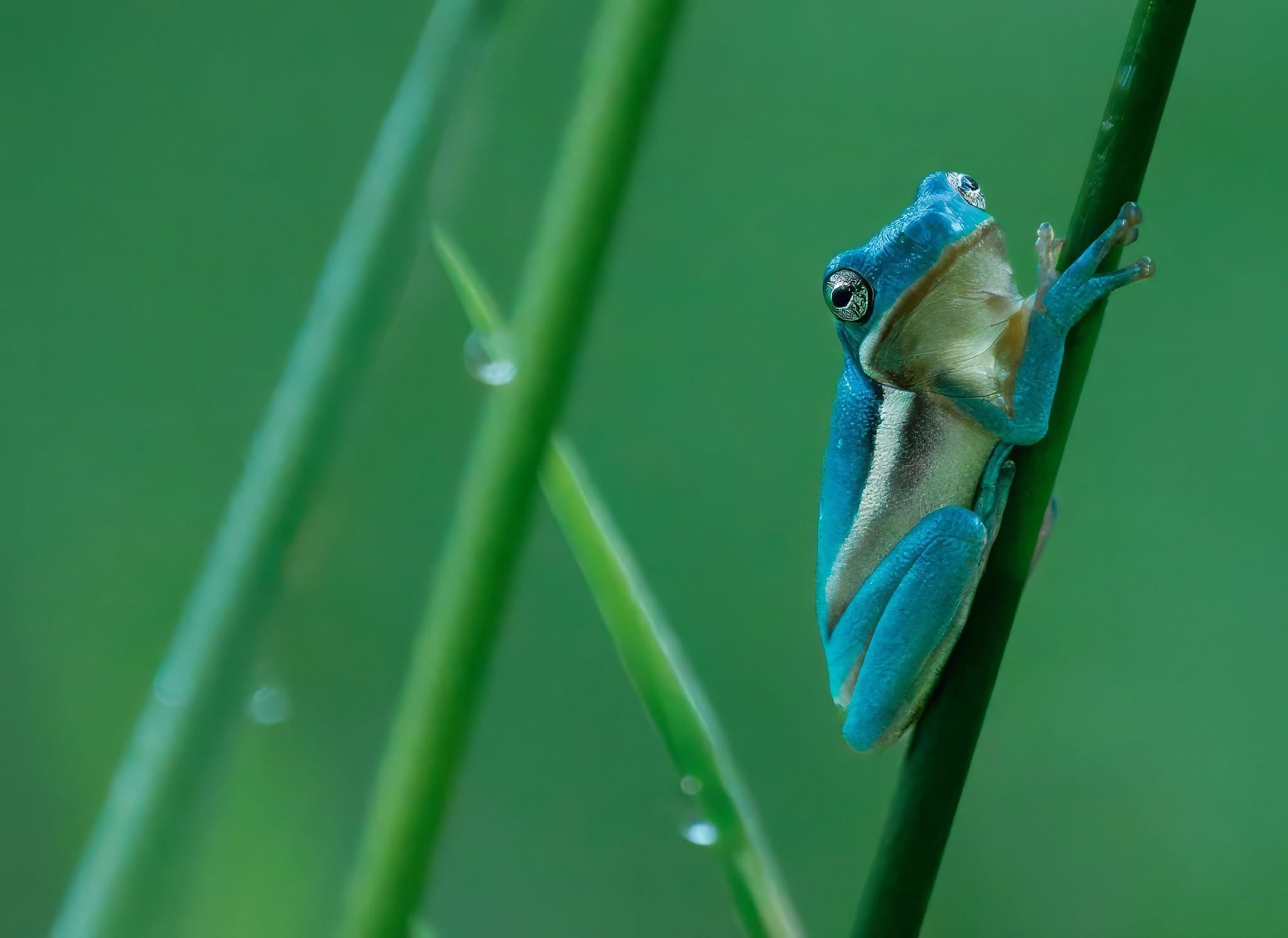
ALEXANDRIA (FAIRFAX COUNTY), VA — First came the family of four river otters. Now Huntley Meadows Park has another scene-stealing resident—and this one is tiny, bright blue and remarkably difficult to find.
Meet “Bluey,” an American green tree frog with such unusual coloring that photographers and nature lovers have been visiting the park’s wetlands in hopes of catching a glimpse.
Bluey has reportedly been seen consistently since August 10. The frog’s startling color, coupled with its habit of tucking itself almost invisibly among tall green stems, has quickly turned the little amphibian into Huntley Meadows’ newest celebrity.
On August 18, photographer Mar Acevedo captured Bluey peeking around a plant stem, one tiny foot wrapped around the vegetation.
“Since this special frog has been consistently seen since Aug. 10, we have affectionately named him ‘Bluey,’” Acevedo wrote. “He is not an easy find, but when you see him, your heart sorta melts. Who’s gooey for Bluey?”
The photograph looks almost posed: Bluey’s face emerging from the greenery, one large eye trained on the camera.
Acevedo, a retired public school teacher from Springfield, is already well known for his ability to find Huntley Meadows’ smallest residents. In an earlier Fairfax County Park Authority profile, a fellow photographer dubbed him the “tree frog king.”
His familiarity with the frogs and their habitat came in handy with Bluey. According to The Washington Post, Acevedo once waited more than four hours for the elusive frog to reappear within a small patch of the sprawling park.
The wait paid off—and his photographs helped introduce Bluey to a much larger audience.
Bluey Faces the Cameras
By August 25, the day after the Post published its feature, Bluey was still appearing for photographers.
Parameswaran Ponnudurai captured the frog clinging upright to a slender green stem, its blue face turned directly toward the camera.
“This little blue star seems perfectly aware of the attention—looking straight into the camera as if to say, ‘Yes, I know why you’re here,’” Ponnudurai wrote.
Then he offered a thought for the park’s less-celebrated amphibians:
“Meanwhile, dozens of perfectly good green tree frogs at Huntley are wondering what all the fuss is about.”
Although Bluey’s admirers affectionately refer to the frog as “he,” its sex has not been publicly confirmed.
Why Is a Green Tree Frog Blue?
Bluey is an American green tree frog, currently classified scientifically as Dryophytes cinereus. The species was formerly classified as Hyla cinerea, the scientific name that still appears in some references and social-media posts.
Ordinarily, members of the species range from olive green to vivid chartreuse. Bluey’s unusual appearance is associated with a condition called axanthism, in which the yellow pigmentation normally present in the skin is reduced or absent.
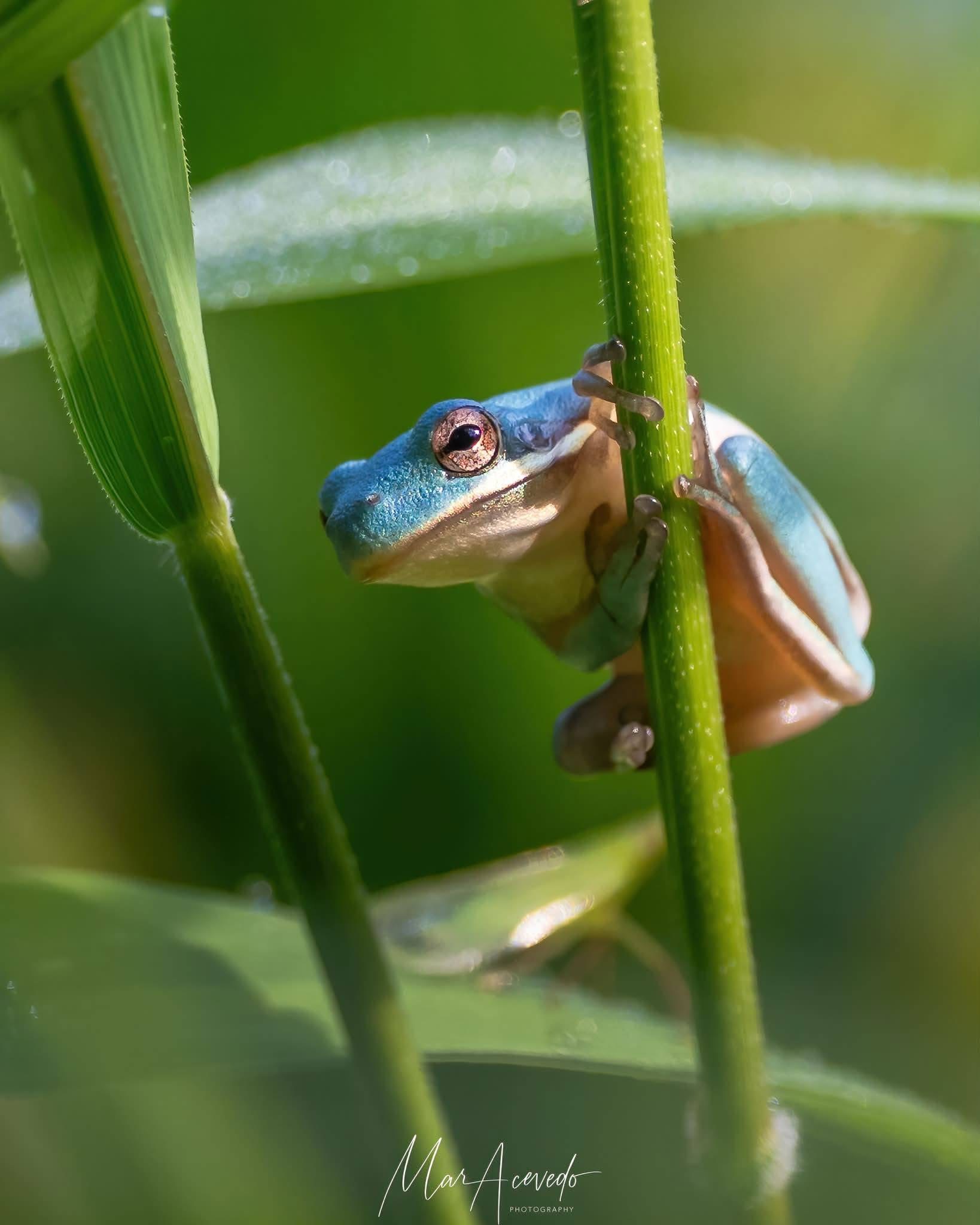
Without that yellow component, a frog that ordinarily appears green can look blue.
Scientists still do not fully understand why axanthism occurs in wild frogs. Genetic mutations, diet and environmental conditions have all been raised as possible factors.
The phenomenon is so rarely documented that researchers have turned to photographs submitted by nature lovers around the world to learn more about it.
A peer-reviewed study published in the Journal of Herpetology in 2025, “The Blue Frogs Project: Leveraging Community Science Data to Document Axanthism Hotspots Across the Globe,” identified more than 300 records of axanthism across 36 frog species using observations posted to the community-science platform iNaturalist.
The research also revealed intriguing geographic patterns.
Rayna Bell, a curator of herpetology at the California Academy of Sciences and one of the study’s authors, told the Post that the Washington region—particularly areas east of Interstate 95—appears to be a hot spot for blue-colored members of the green tree frog species.
Why that concentration exists remains a mystery.
Another Huntley Meadows Sensation
Located in Fairfax County roughly 6½ miles south of Old Town Alexandria, Huntley Meadows is a little more than 1,500 acres, according to the park’s official history.
The park has long been one of Northern Virginia’s premier wildlife-watching destinations. Its boardwalk and observation areas give visitors opportunities to see beavers, herons, turtles, frogs, dragonflies and—on particularly lucky days—even river otters.
This August, the otters and Bluey have provided an extraordinary reminder of how much life can remain hidden in a wetland—and how quickly one remarkable photograph can bring a community together.
Anyone hoping to see Bluey should be prepared to look carefully and wait patiently. Visitors should also remember that Bluey is a wild animal living in sensitive habitat.
Fairfax County asks visitors to walk slowly on the boardwalk, keep voices at conversational levels and avoid behavior that disturbs wildlife. Dogs and other pets are not permitted on the Heron or Restoration trails, including the boardwalk. Fishing and netting are also prohibited. Complete guidance is available on the park’s visitor guidelines page.
Visitors should not touch the frog, leave the designated trail or disturb vegetation in pursuit of a photograph.
After all, Bluey may be famous now, but this tiny star is still a wild animal at home.
And somewhere nearby, dozens of perfectly good green tree frogs may still be wondering why nobody brought a telephoto lens for them.
For directions, park information and current operating hours, visit the official Huntley Meadows Park website. The Norma Hoffman Visitor Center is located at 3701 Lockheed Blvd., Alexandria.