Historic Restoration Completed on the George Washington Masonic National Memorial Exterior


By Shawn Eyer
Alexandria, VA – The George Washington Masonic National Memorial, known affectionately to Alexandrians simply as the Masonic Temple, was erected over a century ago to honor the memory and legacy of the nation’s first president. Ever since, it has stood as a stately sentinel over our community: a landmark that we closely associate with home.
Over time, the Memorial has suffered the indignities of age: degraded mortar, lime deposits, cracked stone, water penetration, and discoloration. Embarking on a national-scale fundraising campaign to address the need for restoration, the Memorial sought the assistance of the general public as well as the Masonic fraternity. After a careful survey of the work needed, the restoration began in 2014 with Paul Keegan and his crew at Hibernia Masonry.

Because most of the problems with water penetration came from the top of the building’s iconic tower, the team began working at the pyramid level above the temple’s ninth floor. After these issues were addressed, the work moved down the tower one level at a time.
Residents surely noticed the massive scaffolding slowly progressing from top to bottom of this neoclassical structure’s façade.
Cracks in the stone were sealed with epoxy. All of the original mortar was “raked out,” and each joint was repointed with a long-lasting mixture that allows moisture to escape rather than remain and go through freeze-thaw cycles. Weather-capping was installed. New LED lighting was installed to allow for the tower to be lit in many colors. Efflorescence—lime deposits often visible from the ground—was chipped away. In certain places, significant structural damage was repaired using steel rods.

In 2015, in the midst of this work, the Memorial earned designation as a National Historic Landmark, drawing media attention and renewed support from around the country. With each new work season, the Memorial emerged, floor by floor, in better condition than it had been for generations.
The front of the building’s portico was reached in 2022. Above the entrance there is a large medallion depicting George Washington in profile. This was the work of Gail Sherman, a sculptor who was the wife of the Memorial’s architect, Harvey Wiley Corbett. It was carved in place from a single block of stone in 1927.

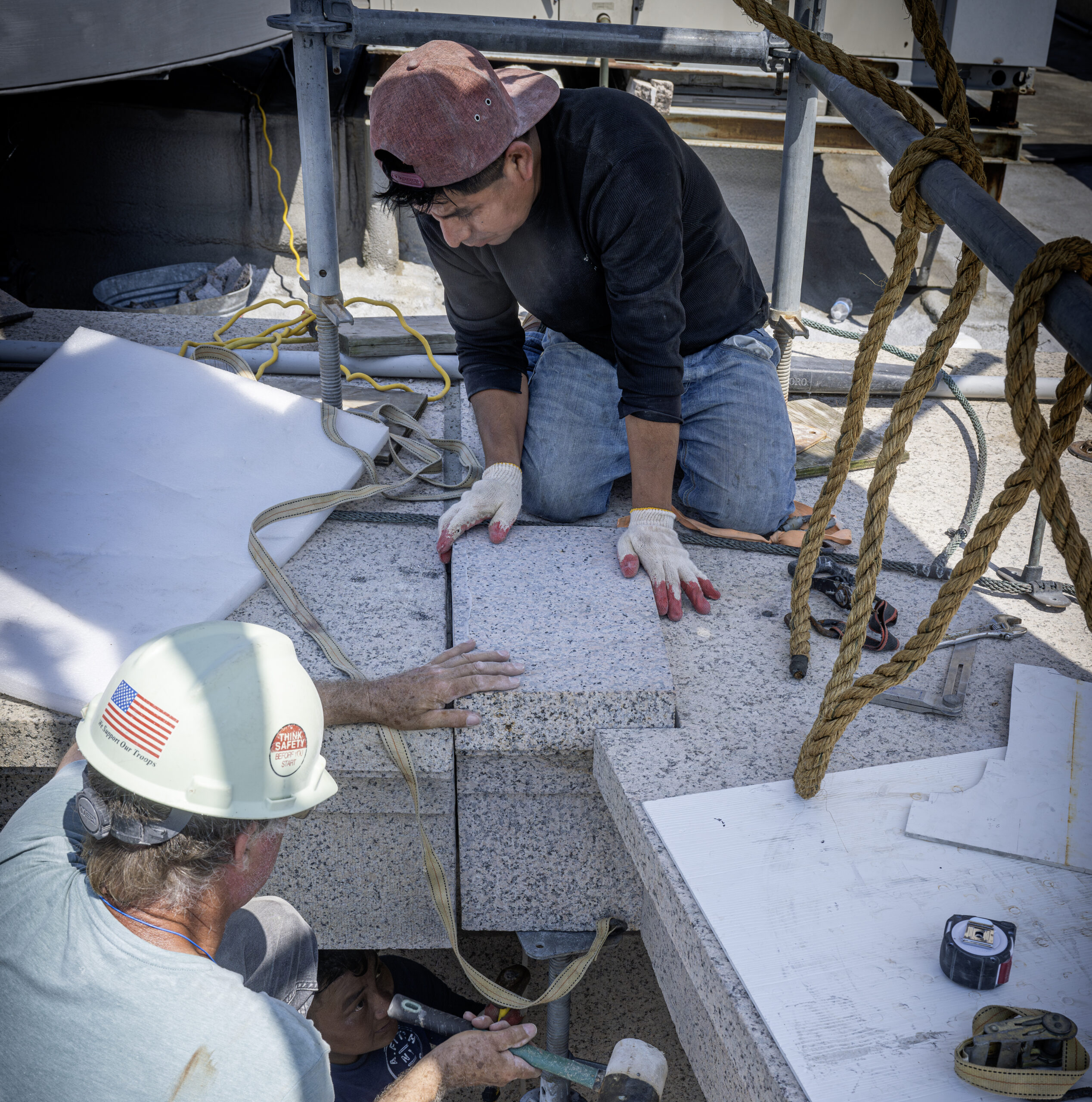
For the last several years now, the work has neared completion with the scaffolding located behind the building, along the outer wall of the Memorial’s theater. Finally, the restoration of the temple was completed last month when workers lowered a newly-carved “Dutchman’s repair” into a niche where the 2011 earthquake had caused the coping to split. Now, that damage is completely invisible, and the integrity of the building is restored from top to bottom.
For the first time in a generation, it is possible to see the building in as stately a condition as that when it was first erected: a beautiful beacon of light with a positive and inspiring message.
Shawn Eyer has worked at the George Washington Masonic National Memorial for thirteen years. He is the museum’s Managing Director of Communications and Education.