Frederick Douglass and the Alexandria Juneteenth Connection Few People Know About
Long before Juneteenth became a federal holiday, the famed abolitionist came to Alexandria to celebrate freedom—and his legacy still lives on here today.

ALEXANDRIA, VA — Every Juneteenth, Americans commemorate June 19, 1865, the day Union troops arrived in Galveston, Texas, and informed enslaved people they were free—more than two years after President Abraham Lincoln signed the Emancipation Proclamation.
But few Alexandrians realize that one of the nation’s most influential champions of freedom once came here to celebrate emancipation.
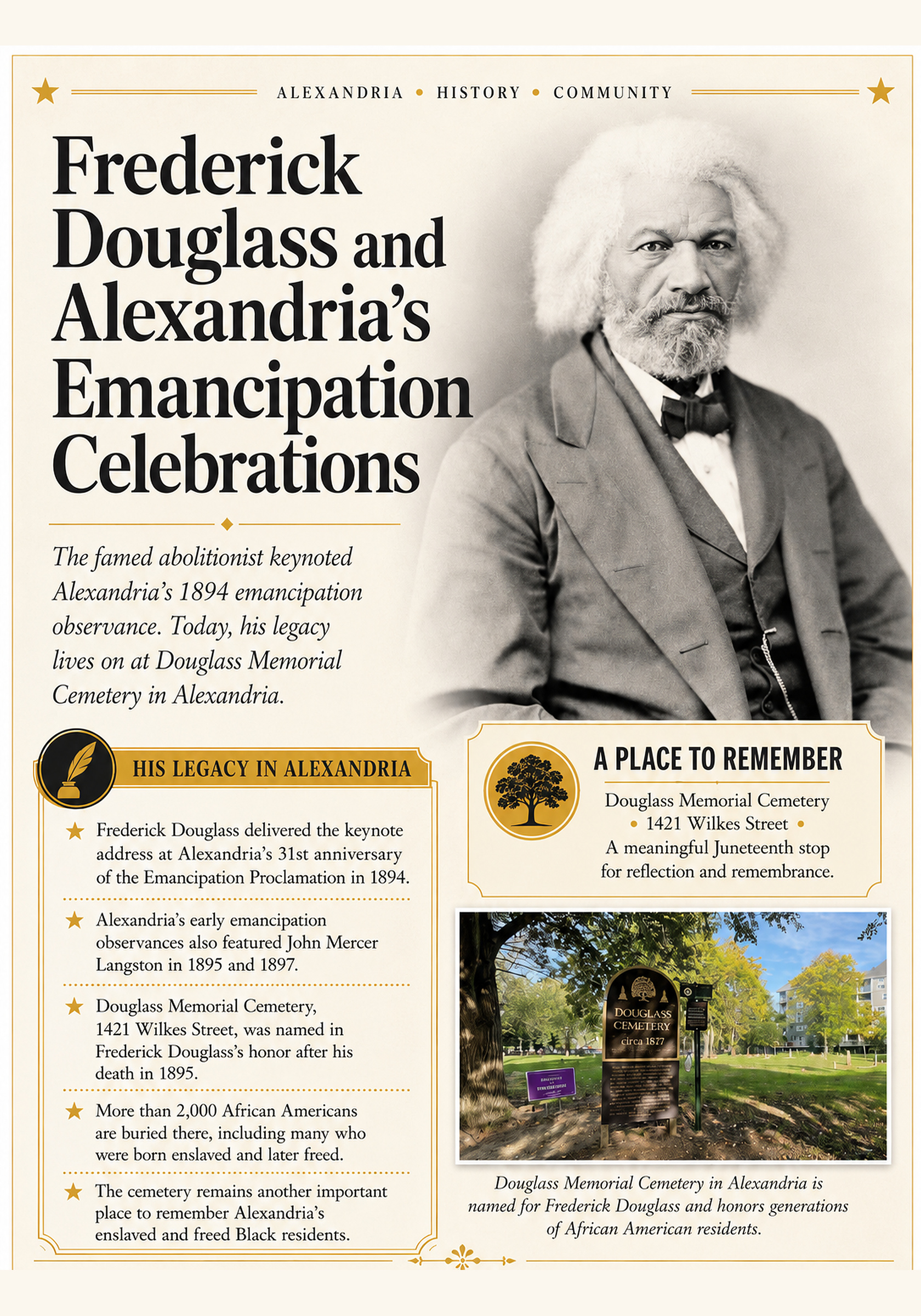
On April 16, 1894, Frederick Douglass delivered the keynote address at Alexandria’s Emancipation Day celebration, marking the 31st anniversary of the Emancipation Proclamation. The former enslaved man who had become an internationally known abolitionist, author, newspaper publisher, and statesman stood before a crowd in Alexandria and spoke about freedom, citizenship, and the unfinished work of equality.
It would be one of the final chapters of an extraordinary life.
Less than a year later, Douglass would be dead.
Yet more than 130 years later, his connection to Alexandria remains visible throughout the city—and especially meaningful during Juneteenth.
From Enslavement to National Leadership
Born into slavery in Maryland in 1818, Douglass escaped bondage at age 20 and went on to become one of the most powerful voices of the 19th century.
Through his speeches, writings, and activism, he exposed the brutality of slavery and pushed America to live up to its founding ideals.
He advised presidents, recruited Black soldiers for the Union Army during the Civil War, advocated for voting rights, and became one of the most respected public figures of his era.
Yet Douglass never stopped reminding Americans that freedom required constant vigilance.
“Power concedes nothing without a demand. It never did and it never will,” he famously said.
That message remains central to Juneteenth today.
Alexandria’s Complicated History
Douglass’s appearance in Alexandria carried special significance because of the city’s own history.
Before the Civil War, Alexandria was one of the nation’s busiest centers of the domestic slave trade. Thousands of enslaved men, women, and children passed through the city’s markets, warehouses, and waterfront before being transported south.
Today, sites such as the Freedom House Museum and the Contrabands and Freedmen Cemetery Memorial preserve the stories of those who endured slavery and those who sought freedom.
By the time Douglass arrived in Alexandria in 1894, the city had transformed dramatically.
Formerly enslaved residents had established churches, schools, businesses, and civic organizations. Alexandria’s Black community organized annual emancipation celebrations that brought together families, veterans, ministers, educators, and community leaders.
Douglass’s appearance as keynote speaker was both a celebration of progress and a reminder that the struggle for equality continued.
Alexandria’s Emancipation Celebrations
Long before Juneteenth became a national holiday, Alexandria’s African American community held annual observances commemorating emancipation.
These events were among the most important civic gatherings of the year.
Parades, speeches, music, church services, and community celebrations honored the end of slavery while recognizing the work that remained ahead.
Douglass was not the only prominent figure to address these gatherings.
Civil rights pioneer and educator John Mercer Langston also spoke at Alexandria’s emancipation celebrations in 1895 and 1897, helping establish the city as an important center of African American civic life during the post-Civil War era.
Today, Juneteenth carries forward many of the same themes those early emancipation celebrations embraced: freedom, remembrance, resilience, and community.
A Cemetery That Bears His Name
One of the most visible reminders of Douglass’s Alexandria connection sits quietly on Wilkes Street.
Located at 1421 Wilkes Street, Douglass Memorial Cemetery was named in honor of Frederick Douglass following his death in 1895.
Did Douglass Once Stand Here?
There is one intriguing possibility that local historians continue to explore.
Some historical accounts suggest Frederick Douglass may have delivered part of his 1894 Emancipation Day remarks on or near the grounds that later became Douglass Memorial Cemetery. Other accounts place portions of the day’s celebration elsewhere in Alexandria. While researchers continue working to verify the exact location of Douglass’s address, the possibility that he once stood on the same ground that now bears his name adds another remarkable chapter to Alexandria’s connection with the famed abolitionist.
Established in 1877, the cemetery became the final resting place for generations of African American Alexandrians during a time when segregation limited burial opportunities elsewhere.
More than 2,000 people are buried there, including many who were born enslaved and later lived to experience freedom.
Walking through the cemetery today offers a powerful reminder that Alexandria’s Black history is not an abstract story. It is the story of real people whose lives helped shape the city.
Teachers, laborers, veterans, business owners, church leaders, and families who endured slavery, Reconstruction, Jim Crow, and social change all rest there.
For many residents, Douglass Memorial Cemetery remains one of Alexandria’s most important—but least visited—historic sites.
Why Juneteenth Matters
Juneteenth is often described as America’s second Independence Day.
The holiday celebrates the moment when freedom finally reached the last enslaved Americans in Texas and acknowledges the long struggle required to make emancipation a reality.
For Douglass, freedom was never simply the end of slavery.
It meant education.
It meant economic opportunity.
It meant voting rights.
It meant full citizenship.
And it meant ensuring future generations understood the sacrifices that made freedom possible.
“Freedom is a road seldom traveled by the multitude,” Douglass once observed.
His words still resonate as communities across the nation gather to celebrate Juneteenth.
Juneteenth Events in Alexandria
Residents looking to honor Juneteenth locally have several opportunities to reflect on Alexandria’s African American history and the legacy of freedom:
Memorial at Douglass Cemetery
Friday, June 19 | 10–11:30 a.m.
Douglass Cemetery, 1421 Wilkes Street
A community gathering honoring those buried at the historic cemetery named for Frederick Douglass and reflecting on Alexandria’s African American history.
Juneteenth Concert with Washington Revels Jubilee Voices
Friday, June 19 | 1 p.m.
Shiloh Baptist Church Worship Center, 1401 Jamieson Avenue
A free concert celebrating freedom through music and storytelling while highlighting the history of Alexandria’s Civil War-era Black churches.
Alexandria Juneteenth Celebration
Friday, June 19 | 4–8 p.m.
Charles Houston Recreation Center, 901 Wythe Street
The city’s annual Juneteenth celebration featuring live music, food, exhibitors, and community activities honoring the history and future of Alexandria’s Black community.
Freedom Before Emancipation: Family Day
June 19–20
George Washington’s Mount Vernon
A special family program exploring how enslaved people resisted bondage and sought freedom before emancipation
His Legacy Lives On
The story of Frederick Douglass and Alexandria is one many residents have never heard.
Yet it is woven into the city’s history.
When Douglass stood before Alexandrians in 1894, he represented something extraordinary: a man born into slavery addressing a community celebrating freedom.
Today, as residents gather for Juneteenth events, visit Douglass Memorial Cemetery, or explore Alexandria’s historic sites, they participate in a tradition rooted in the same ideals Douglass spent his life advancing.
His visit to Alexandria was brief.
His impact was not.
And perhaps that is the Alexandria Juneteenth connection few people know about: one of America’s greatest champions of freedom once came here to celebrate it—and his legacy remains part of the city’s story today.