Ever Wonder Why Del Ray Is Called Del Ray?
The history of Alexandria's beloved neighborhood is remarkably well documented—except for one surprising detail that historians still can't fully explain.

ALEXANDRIA, VA – If you have lived in Alexandria for any length of time, chances are you have spent time in Del Ray.
Maybe you’ve spent a Saturday morning at the farmers market, browsed the quirky independent shops along Mount Vernon Avenue—where “Main Street Still Exists” is more than a slogan—or settled into one of the neighborhood’s beloved restaurants.
Perhaps you’ve brought the family to the annual Halloween Parade, celebrated First Thursdays, joined a holiday bar crawl, or been one of the approximately 50,000 visitors who flock to Mount Vernon Avenue each fall for Art on the Avenue, when more than 300 artists transform the neighborhood into one of the region’s premier outdoor arts festivals. Whatever brought you there, Del Ray has a way of making people feel like they’ve stepped into a small town tucked inside a city.
But have you ever stopped to wonder why it is called Del Ray?
It sounded like the kind of question with an easy answer.
Instead, it led us through City history pages, preservation documents, old maps, National Register records, and one very intriguing local mystery.
The story of how Del Ray grew is well documented. The reason for the name itself is much harder to pin down.

A Neighborhood With a Well-Documented Past
According to the City of Alexandria’s Office of Historic Alexandria, “The community of Del Ray grew up around the railroad and could be considered one of the first commuting suburbs in the area.” The City notes that, as the 19th century was ending, Del Ray and St. Elmo were being planned north of Alexandria’s city limits and were served by a light railway that could take residents to Washington, D.C., in minutes.
The Virginia Department of Historic Resources gives another key piece of the story. In its record for the Town of Potomac Historic District, DHR states that “St. Elmo and Del Ray, platted in 1894 by Ohio developers Wood and Harmon, were incorporated in 1908 to form the town.”
The City’s Del Ray Pattern Book also describes Del Ray as “one of the earliest street car suburbs in the nation,” laid out in an east-west grid with street trees and sidewalk paths.
So we know a lot.
We know it was platted in 1894. We know the development firm Wood-Harmon was involved. We know the neighborhood was designed around transportation, commuting, modest homes, and small lots. We know the streets were laid out in a grid. We know Potomac Yard helped change everything.
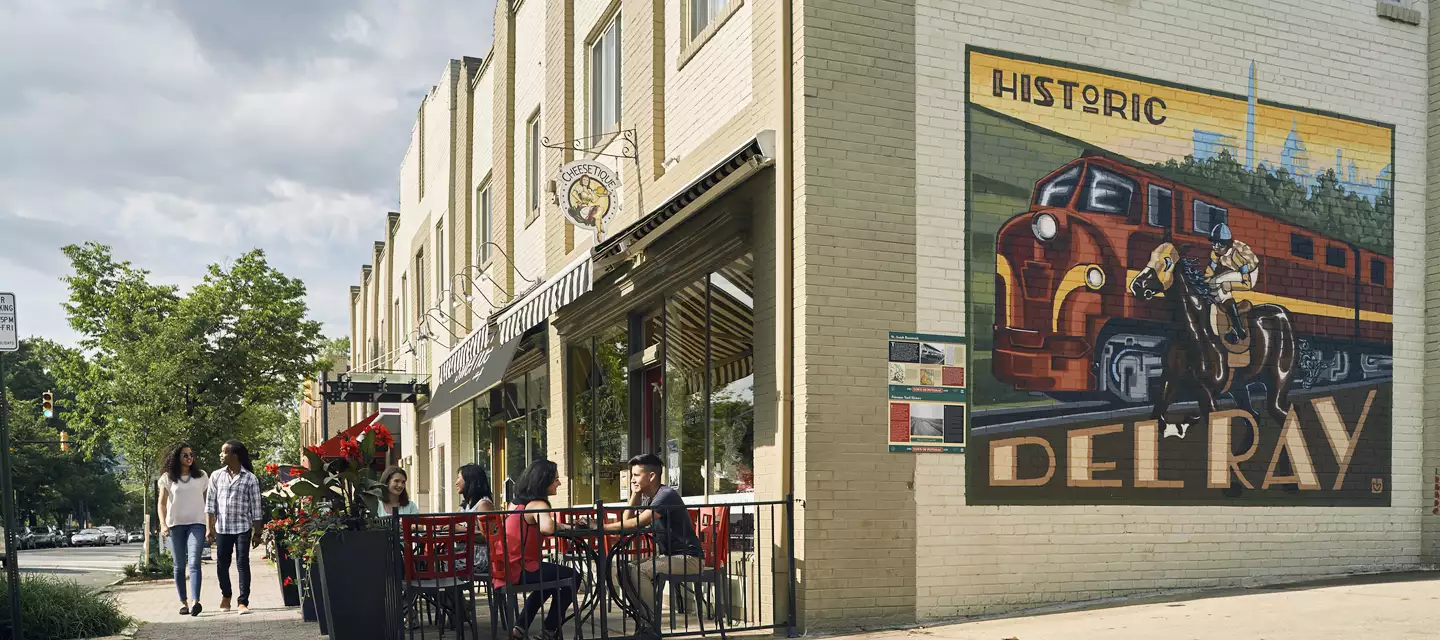
The iconic “Historic Del Ray” mural welcomes visitors to Mount Vernon Avenue, the heart of the neighborhood known for its locally owned shops, restaurants, and community events. Del Ray proudly embraces the slogan, “Where Main Street Still Exists.”
The Mystery of the Name
What the public record does not clearly explain is why the developers chose the name Del Ray.
That is the mystery.
An interpretive sign produced for the Town of Potomac Centennial says the development firm of Wood-Harmon bought two large plots of land in 1894: “a larger one called ‘Del Ray,’ from the estate of John Lloyd, and a smaller one called ‘St. Elmo.’”
That tells us the name was in use very early. But it does not tell us why that name was chosen.
Some locals have wondered whether Del Ray began as Del Rey, the Spanish phrase often translated as “of the king.” It is a tempting theory, especially because romantic Spanish-style names were popular in American place-naming. But so far, the standard local history sources we found use Del Ray and do not document that origin.
Was the name selected because it sounded elegant? Was it connected to a person, a family name, a place name, or a real estate sales strategy? Was there once a brochure, advertisement, or letter that explained it?
If that answer exists, it has not yet surfaced in the standard local history sources.
Del Ray’s story took a dramatic turn in 1906 when nearby Potomac Yard opened. The City of Alexandria says the population of greater Del Ray began to grow significantly after Potomac Yard opened, and in 1908 Del Ray and St. Elmo formed the incorporated Town of Potomac, with its own mayor, council, police, and fire service.
The Virginia Department of Historic Resources adds that many residents commuted by railroad and electric rail to Washington, while others walked to work at Potomac Yards, described as a primary railroad switching facility.
For a time, Del Ray was not just a neighborhood. It was part of its own town.
The City of Alexandria annexed the Town of Potomac in 1930, and the town ceased to exist. But Del Ray did not lose its identity. If anything, the name became stronger.

A Mystery That Lives On
Today, Del Ray is one of Alexandria’s most recognizable neighborhoods, known for independent shops, restaurants, festivals, porches, artists, families, dogs, strollers, and the kind of local spirit that makes people feel at home.
And yet the name itself remains a little elusive.
History usually rewards people who keep asking questions. Somewhere, perhaps in an old newspaper advertisement, a forgotten real estate brochure, or a dusty letter, the answer may still be waiting.
Until then, Del Ray keeps one small secret all to itself.
One More Thing…
While researching Del Ray’s history, we were reminded of another story hiding in plain sight: Alexandria’s catalog homes.
The City’s Del Ray Pattern Book notes that Sears and Roebuck homes were built in the Town of Potomac, with examples on East Windsor Avenue, Del Ray Avenue, and Stewart Avenue. Local writers have covered some of them before, and The Zebra has written about 211 East Oxford Avenue, better known as “The Crab Shack,” a 1925 Sears kit house turned neighborhood music haven.
So our next question is not whether catalog homes existed here. It is this: How many are still standing, how can you spot them, and what stories do their owners know?
We are assigning a Zebra reporter to find out. Look for that story soon in Ever Wonder Why.
From the Publisher’s Notebook
This story began with a coincidence. I grew up in Delray Beach, Florida, and years later found myself living near and working in another Del Ray — this one with a space in the middle. One day it finally hit me.
Why are they both called Del Ray? I assumed the answer would be simple. It was not.
That question inspired this new Friday series.
Each week, Ever Wonder Why will explore the stories behind Alexandria’s neighborhoods, streets, landmarks, traditions, mysteries, and local legends.
If there is something in Alexandria you have always wondered about, send your question to [email protected]. It just might become the next installment of Ever Wonder Why.