From Our Backyard to a Million Miles Away: NASA’s New Space Telescope Begins Its Journey
More Data Than Humans Can Examine Alone

ALEXANDRIA, VA — For those of us living in Alexandria, the American space program can sometimes feel surprisingly close to home. NASA Headquarters sits across the Potomac in Washington, and NASA’s Goddard Space Flight Center is just up the road in Greenbelt, Maryland. We have friends and family who work in the industry, and we are all a bit of busy bodies.

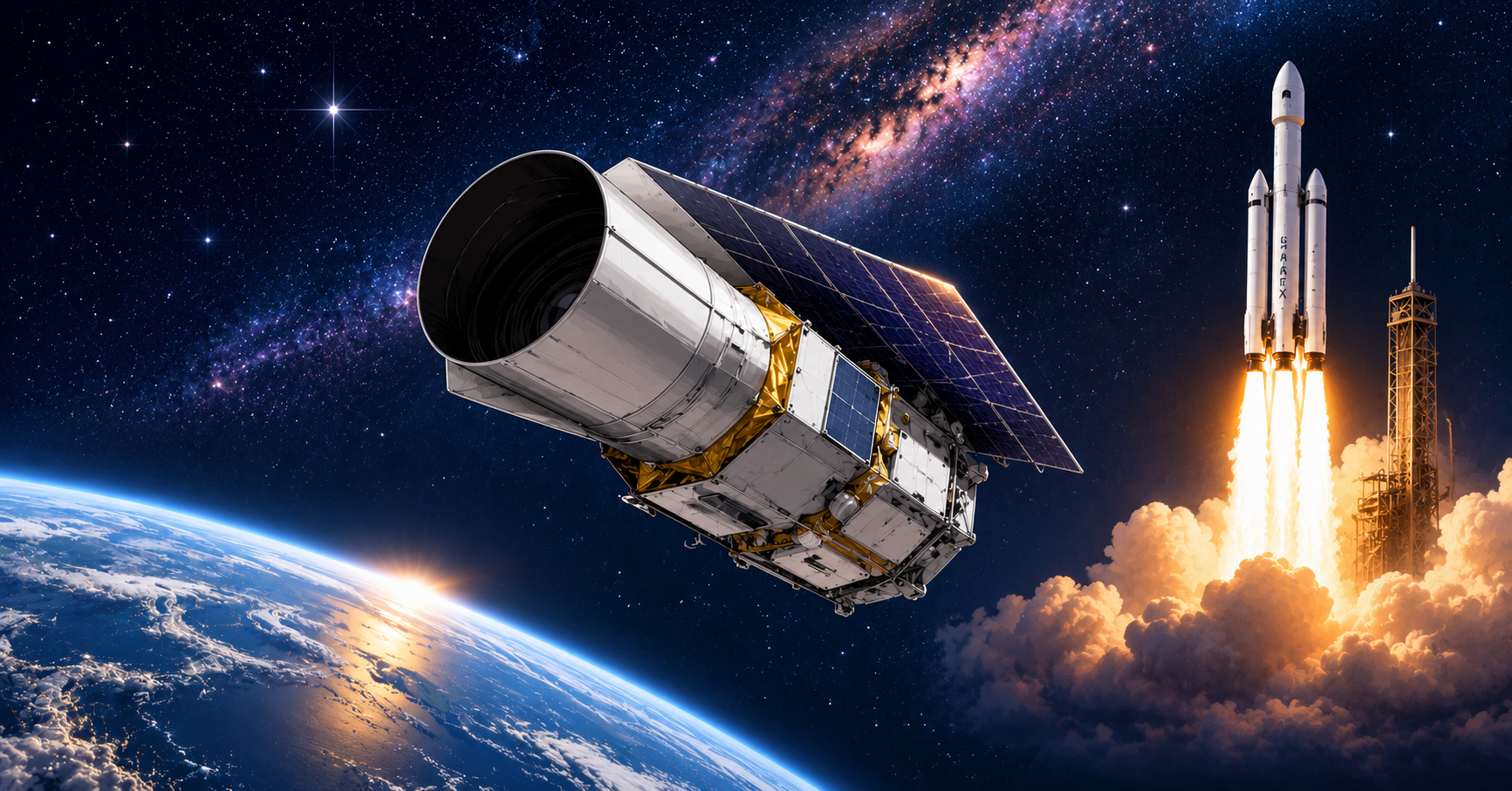
At 7:26 a.m. EDT on August 30, NASA’s Nancy Grace Roman Space Telescope blasted off from Kennedy Space Center in Florida aboard a SpaceX Falcon Heavy rocket.
The telescope carries the name of Dr. Nancy Grace Roman, NASA’s first chief astronomer and the woman known as the “Mother of Hubble.” Before joining NASA in 1959, Roman worked at the U.S. Naval Research Laboratory in Washington, D.C., giving the scientist behind the mission’s name her own connection to our capital region.
A New Eye on the Universe
Roman is now beginning a three-month journey to the second Sun-Earth Lagrange point, known as L2, the same general region of space used by the James Webb Space Telescope and will travel over a million miles away from our planet Earth.
The ground control team at NASA Goddard began receiving “telemetry” from Roman just seven minutes after launch.
Telemetry tells NASA things like its location, speed, temperature, power levels, equipment status, and whether its systems are functioning correctly.

Roman’s primary Wide Field Instrument is a 300-megapixel infrared camera containing 18 detectors. NASA says the telescope will be able to survey the universe approximately 1,000 times faster than Hubble.
Think less like looking through a telescope at one fascinating object and more like creating an enormous, extraordinarily detailed map of the universe.
Scientists hope Roman will help answer some of astronomy’s biggest questions: What is dark matter? What is causing the universe’s expansion to accelerate? How common are planets outside our solar system?
And, eventually, are we alone? Or maybe better, provide the proof that we are not.
Roman’s Coronagraph Instrument will test technology capable of blocking the overwhelming light of a star so scientists can photograph planets orbiting it. Roman will initially target large, Jupiter-like worlds, but the technology could help pave the way for future missions searching for Earth-like planets.

More Data Than Humans Can Examine Alone
Data. Data. Data.
Roman is expected to send back approximately 1.4 terabytes every day, the highest data rate yet for a NASA astrophysics mission, enough to store hundreds of thousands of high-resolution photographs, every single day. Machine learning, artificial intelligence and citizen scientists will help sift through that enormous stream of information and identify discoveries worth investigating.
There is something particularly interesting about that from here in Northern Virginia, where so much of the national conversation about artificial intelligence, data and government technology is happening in our own backyard. Just the other day I took a drive through Ashburn, and the rate of data center construction is astounding.
The telescope successfully deployed its solar panels and lower instrument sunshade shortly after launch. Over the coming months, scientists at Goddard and elsewhere will calibrate its instruments and prepare Roman for science operations.
NASA expects its first images in early 2027.
So while Roman may soon be a million miles away, part of the team listening for it, and waiting to see what it discovers, is right here at home.