
On Saturday, May 30 at the Rachel M. Schlesinger Concert Hall and Arts Center at the NOVA Alexandria Campus held a unique fundraising collaboration between three Alexandria non-profits: Del Ray Artisans (DRA), the Symphony Orchestra League of Alexandria (SOLA),and the Symphony Orchestra of Northern Virginia (SONOVA).
Pictures at an Alexandria Exhibition is a unique partnership with Ararity Auctions which is
hosting an online auction of artwork, curated by DRA Outreach Director Kelly M. MacConomy and DRA Secretary Margaret Slipek, inspired by selections of music performed during SONOVA’s concert event. A percentage of all art sales benefits both the Del Ray ArtisansGallery and SONOVA.
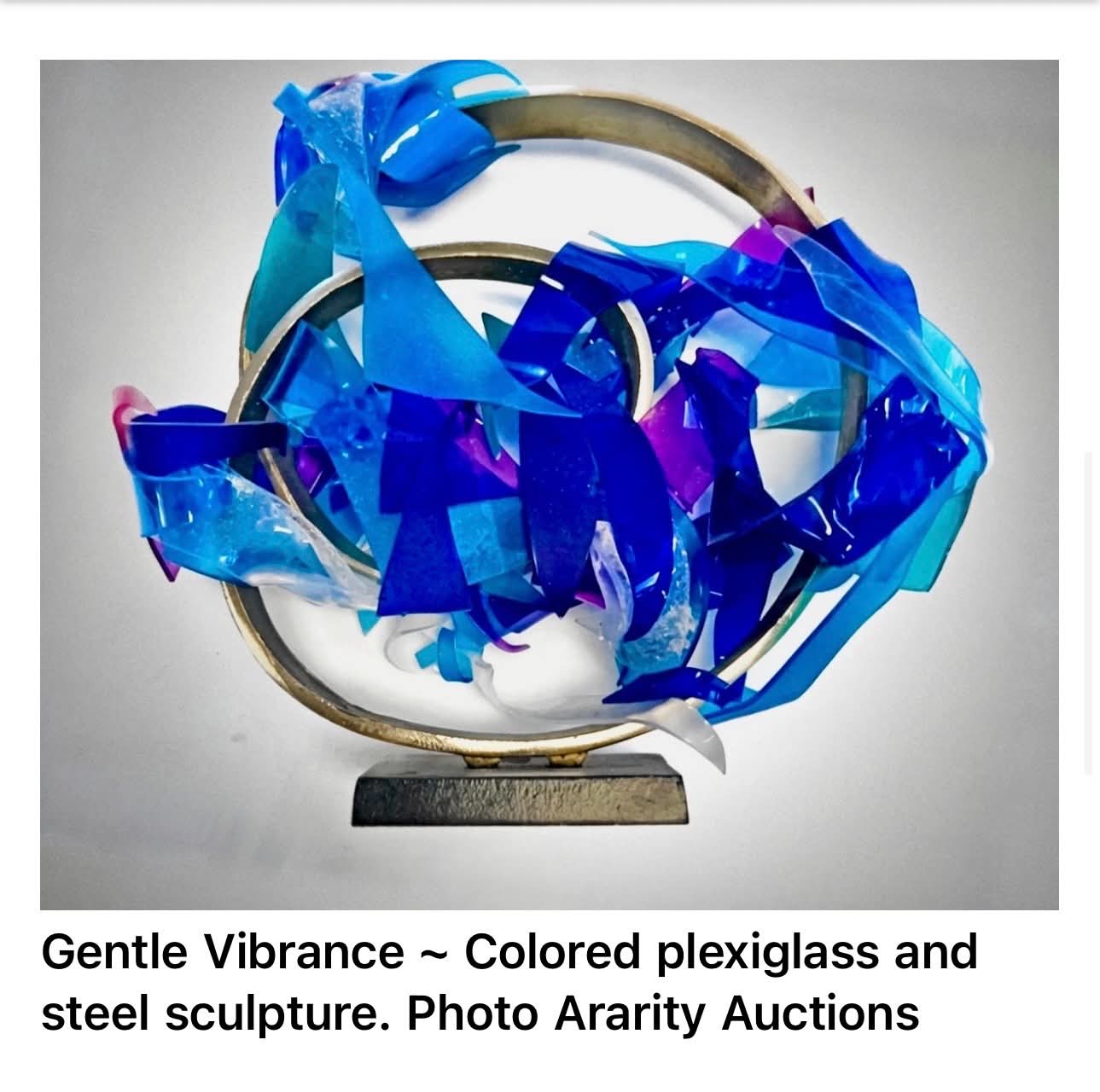
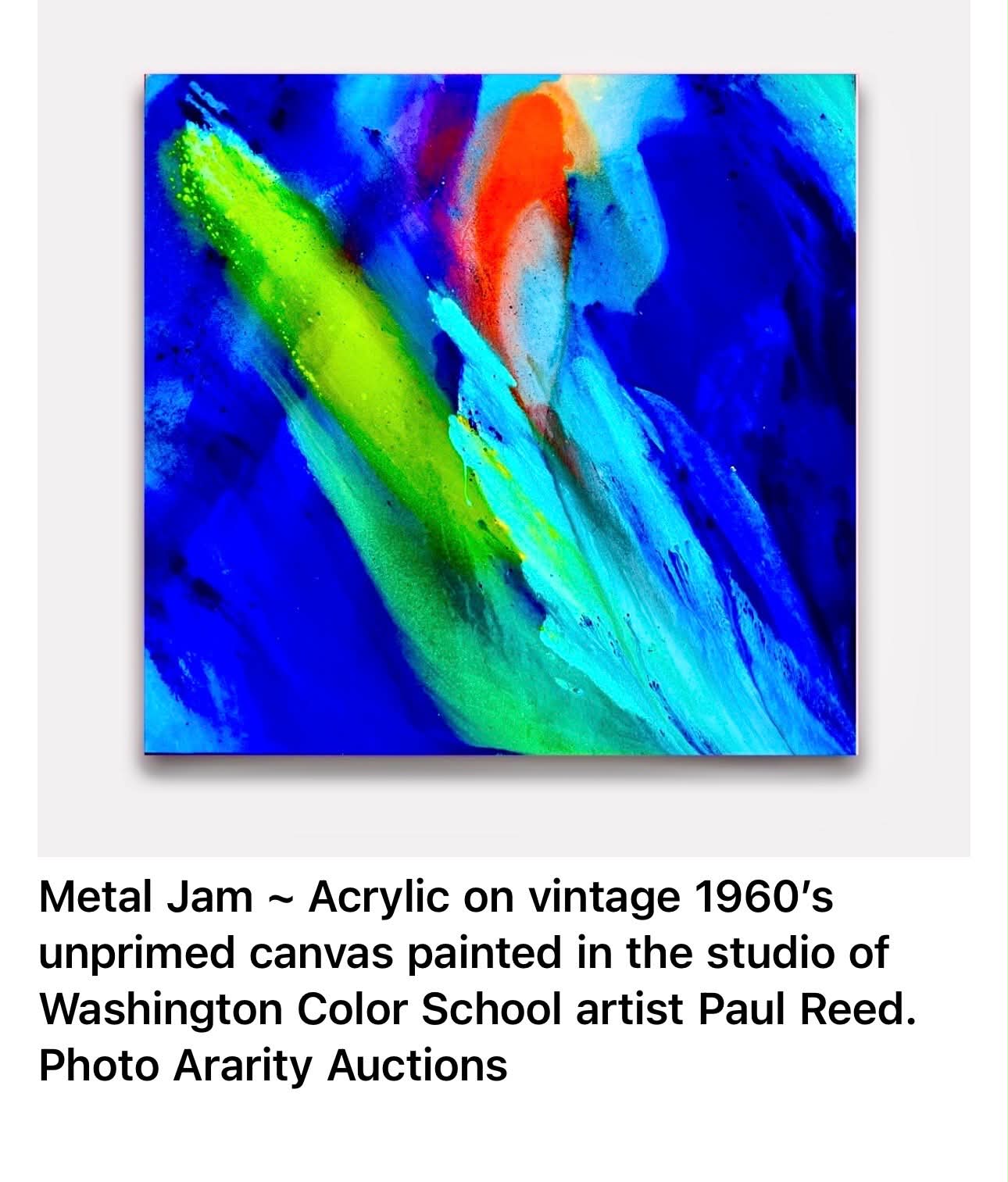
Pictures at an Alexandria Exhibition is honored and most fortunate to be auctioning three works of art by the famous contemporary color field artist Barbara Januszkiewicz: Gentle Vibrance, a colored plexiglass and steel sculpture, Baby, I Love You~ acrylic on metal, and Metal Jam~ acrylic on vintage 1960’s unprimed canvas.
“Narrative paintings can be beautifully descriptive, but it’s in the silence of an abstract field of color where my imagination really begins to roam.” — Barbara
The Zebra spoke with Barbara about her exemplary body of work and dedication to art
education in our community. Following is the interview held shortly before the concert and auction event this Saturday.
Q: Your abstract color field art is stunning. But, like most great abstract artists, you also have expertise in representational work. What led you to focus your body of artwork upon color exploration and expression?
A: “My academic training gave me a solid foundation in drawing and realistic painting, so I teach in this manner- but my own curiosity always drifted toward what happens when you strip away the narrative and let color carry the meaning.”
”For about 25 years I taught watercolor classes for the Corcoran School of Art and McLean
Project for the Arts. Teaching painting encompasses the elements of art, which most
lessons/demos often need to be in narrative /representational subjects so my students could build their skills from creating…. let’s say a landscape.”
“I became fascinated with transparency—how one hue can veil or collide with another,
how a field of color can feel like sound or weather, rather than an object. Over time, I
realized that I could easily paint anything. And I won many awards for these works. Yet
something was missing. I truly get excited pondering, could just color be that immersive,
lyrical space where color is the subject, the emotion, and the story all at once? Teaching
and painting in a narrative style was just the tool to give me the skill to jump to pure
abstraction.”

“For me, there is more room for wonder in abstraction; the viewer is invited to imagine,
question, and discover, rather than simply read a scene.” — Barbara
Q: Your friend and mentor, the late Paul Reed, was a pioneer giant of the Washington Color School. How did you come to know and study with him?
A: “I first crossed paths with Paul Reed while I was researching and producing a documentary on the Washington Color School, over a decade ago- trying to understand that moment when painters in D.C. pushed color into a new, more experimental territory. By the time I met Paul, I had already developed my own organic, brush‑based approach to painting color fields, but I was still primarily working in watercolor on paper.”
“Paul saw something in that work and gently, but very firmly, encouraged me to move into acrylics on unprimed canvas, to really commit to scale and material the way his generation had.”
“I spent countless hours in his studio—looking at his old canvases, talking about Matisse, jazz, and the evolution of those biomorphic shapes, and even created pieces like Together under his supervision, using original 1960s canvas he had saved. Those conversations and collaborations didn’t just refine my technique; they gave me a living sense of how abstraction can keep reinventing itself across decades.”
“When you sit with an abstract painting, you’re not just looking at an image—you’re engaging in a kind of visual improvisation, a dialogue between your inner world and the work itself.” –Barbara
Q: Music is clearly your passion and inspiration, as you title your work after great pieces of music. What composers and musicians are your musical muse?
A: “Music is a huge part of my studio life. I think of many of my paintings and plexiglass
sculptures as visual scores. I’m especially drawn to composers like Aaron Copland and Ferde Grofé, whose orchestral works have this expansive, cinematic sense of space that translates beautifully into color fields and shifting light.”
“I also respond deeply to American vernacular music— Aretha Franklin, Santana, and the
broader world of jazz and rock and roll because of their rhythm, improvisation, and emotional directness. When I title a work after a piece of music, it’s not about illustration, it’s about capturing the tempo, tension, and release of that sound in layered transparencies of color.”
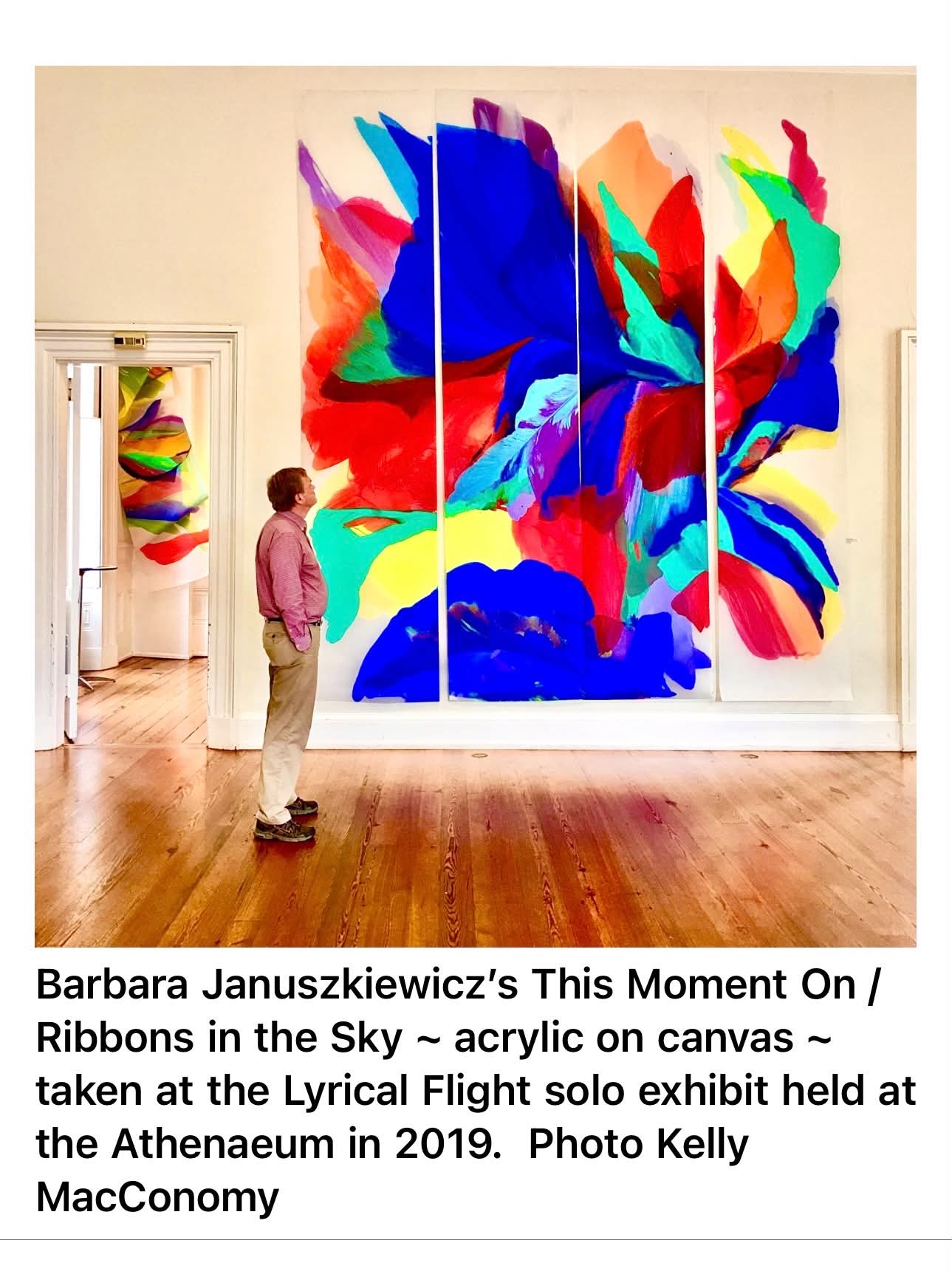
“Abstraction opens up possibilities—each viewer brings their own story to the color and light, so the work keeps changing with every encounter.” –Barbara
Q: The arts are always the first to go in any budget reconsideration. What do you see as the future of the arts in our community and beyond? How can we help foster arts appreciation and greater support among the young and older alike?
A: “I believe the future of the arts depends on how willing we are to treat creativity as a shared public resource, not a luxury line item. In the D.C./DMV region, I’ve seen firsthand how exhibitions, public art installations, and cross‑disciplinary collaborations can change the way people experience their own neighborhoods. Suddenly, color and light are part of daily life, not just something you find in a museum.”
“Not everyone needs to become an artist, but we do need more people living with art, collecting it, and giving themselves time to contemplate great design and visual painting. Art expands our imagination and helps us solve problems in the real world. When we value creative thinking and build it into how we make decisions— in medicine, science, engineering, and everyday civic life— we foster a more open, inventive, and humane society for the future.”
“A quiet reflection on a color‑field abstraction can spark new thoughts and visions, while a
narrative painting often captures just a single moment in time.” –Barbara Januszkiewicz
Barbara Januszkiewicz is a Washington, DC–area abstract artist whose work extends the
legacy of the Washington Color School into contemporary painting and plexiglass sculpture. Known for luminous color fields inspired by music, improvisation, and light, she creates immersive works that function as “visual scores” for the viewer’s imagination. A longtime educator and advocate for the arts, she continues to champion creativity as an essential part of community life.
For more information on Del Ray Artisans go to delrayartisans.org
For more information about the concert and tickets go to https://sonovamusic.org/
And if you were wondering, Barbara”s favorite color is orange some days, lavender and purple other days!