
Alexandria Post Office History: One of America’s First Postal Services

By Daniel Lee
Alexandria, VA – Mail was transported to this area as early as 1695, but there’s no sign of a mail system until 1745 at the earliest. Before the physical establishment of a post office, early taverns served as places to send and receive mail, as was the case throughout the American colonies.
Alexandria’s first postmaster was Robert McCrea, who served from 1776 to 1793. The son of some of the first settlers of Alexandria, McCrea served as postmaster until his death. His son John succeeded him at the appointment of President George Washington, and John stayed in office until the end of John Adams’ presidential term in 1801. The significance of the post is reflected in the fact that it required a presidential appointment and that most postmasters in the pre-Civil War years had both a personal connection to the president who appointed them and military experience.
For instance, Col. George Gilpin served as postmaster during the term of James Madison. Gilpin had been the town surveyor for many years, but he had also been an honorary aide to Washington when he was appointed as commander in chief by Adams in the quasi-war with France.
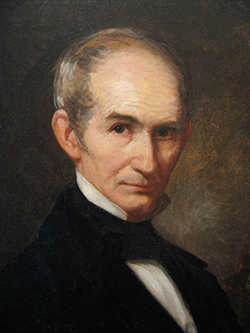
Daniel Bryan served our city as postmaster longer than anyone else in the 19th century. First appointed in April of 1821, Bryan stayed in the position until 1853. This spanned the administrations of James Monroe, John Quincy Adams, Andrew Jackson, Martin Van Buren, William Henry Harrison, James Polk, Zachary Taylor, and Millard Fillmore. Formerly a school teacher, he married the daughter of the Honorable Philip P. Barbour. Known as a quiet citizen and a devotee of literature, Bryan and his young family lived at the Lloyd House on the corner of Queen and Washington after Benjamin Hallowell left as a tenant. Bryan was also the postmaster who issued the “Alexandria Blue Boy” provisional stamp to James Wallace Hooff.
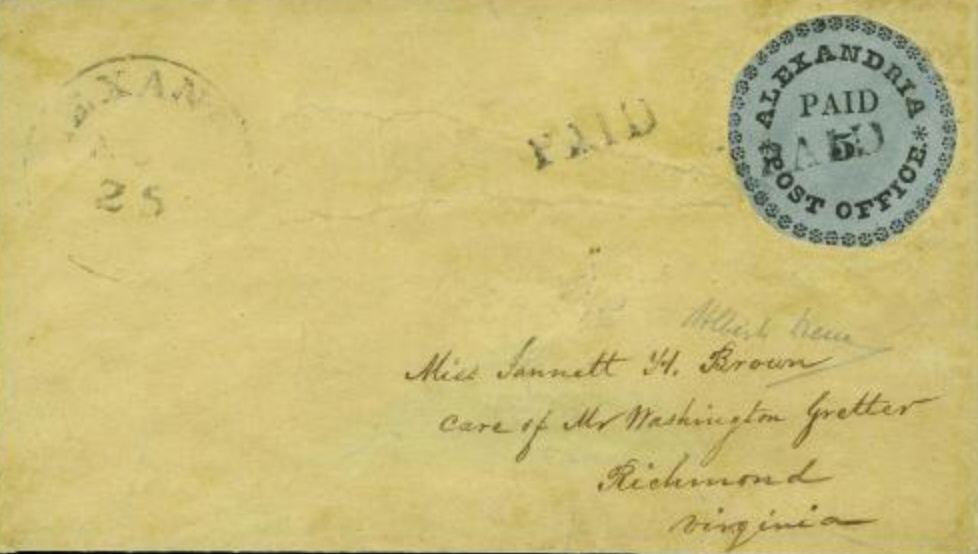
In November 1846, Hooff mailed a love letter to his girlfriend, Jannett Brown, who was visiting relatives in Richmond. The couple was secretly engaged, but Hooff, fearful of the disapproval of the Brown family, asked her to burn the letter as usual. For some reason, she didn’t follow his instructions and saved not only the letter, but the stamped envelope. More than a hundred years later, that stamp, known as the “Alexandria Blue Boy Provisional,” was sold for $1 million.
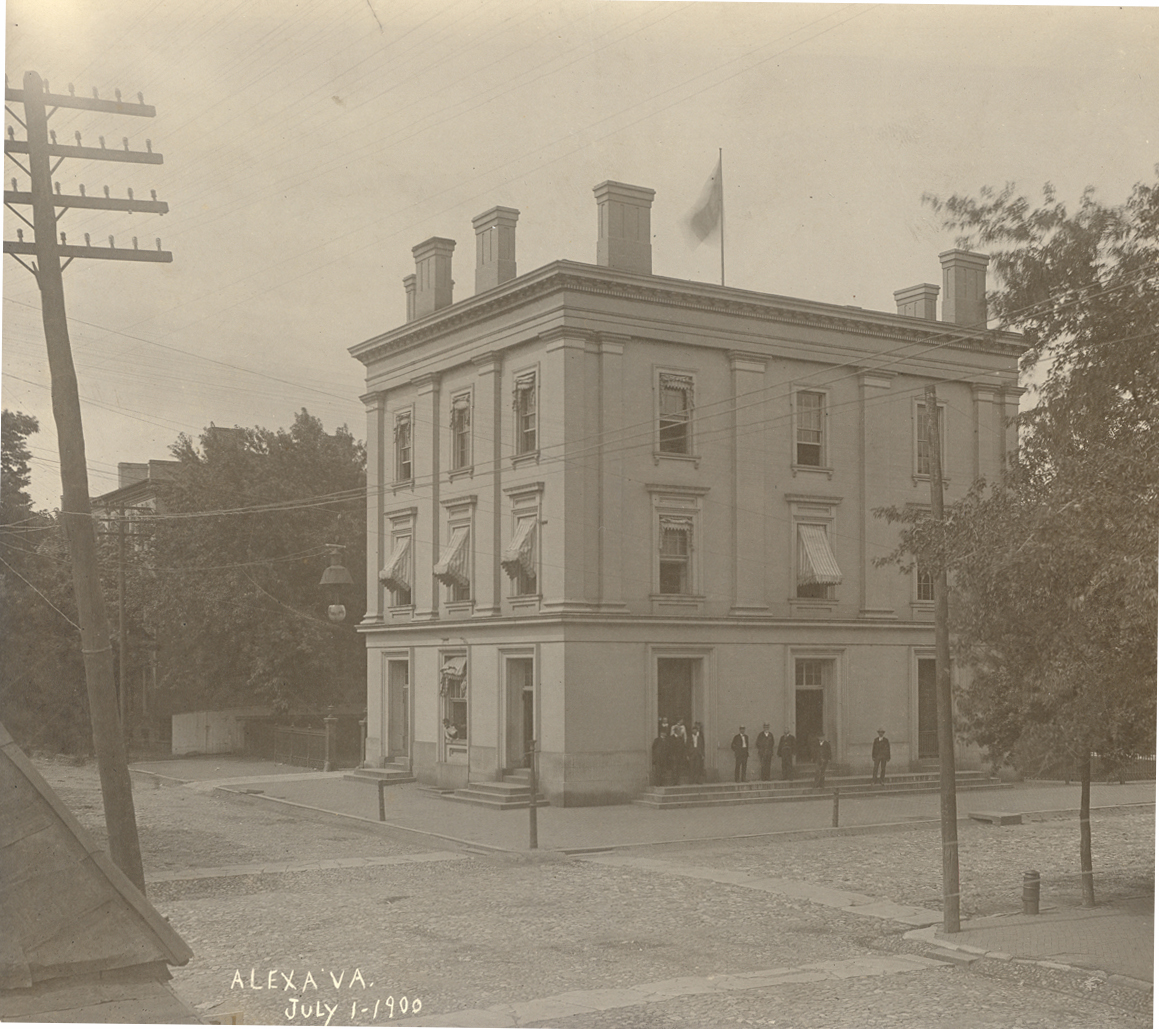
In 1858, the Alexandria Custom House and Post Office was built at the southwest corner of Prince and St. Asaph streets. It was a fireproof structure, made of granite with cast-iron doors, window frames, and stairways. In 1902, when a fire broke out in the basement, there was significant smoke but no damage to the building. In the fall of 1930, 72 years after it was built, the old custom house was razed.
A notable postmaster of Alexandria who served in the Custom House was Nicholas Trist, from 1870 to 1874. Previously, Trist had been Assistant Secretary of State and had negotiated the Treaty of Guadalupe Hidalgo, which ceded California and New Mexico to the United States from Mexico. Trist died in Alexandria in 1874.
The role of postmaster meant something much different in the 19th century than it does today. Just as, if not more important than getting communication to residents in a timely manner, political connections seem to have been a prerequisite for the position.


