

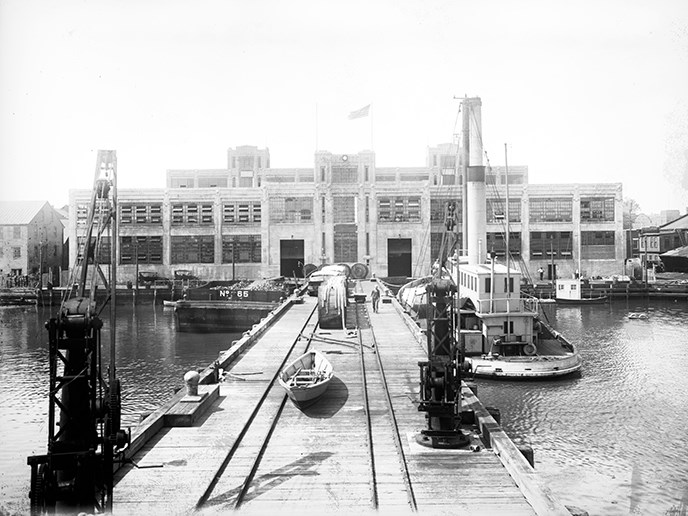
Alexandria, VA – Our August image continues the theme of retracing Alexandria’s transformation from a smaller Southern town into the vibrant city it is today. The photograph takes us to the 100 block of North Union Street, focusing on the Torpedo Factory circa 1979.
The complex was initially constructed in 1918 to support America’s defense effort during World War I. Ironically, the armistice to end the war was signed on the very day construction began. The gray structure on the left—known as Building 1 or the “doughnut building”—featured a large open courtyard at its center, allowing natural light to flow across all four levels for workers assembling torpedoes. This building was demolished in the mid-1980s to make way for the Residences at the Torpedo Factory, a condominium project by Charles R. Hooff III.
An enclosed gray bridge once connected Building 1 with Building 2, the ochre-colored structure on the right. Building 2, mainly used for storage and administrative functions, still stands on the waterfront. In 1974, it was reborn as the Torpedo Factory Art Center, thanks to a concept put forward by Marian Van Landingham. Renovations in the early 1980s gave the building its more recognizable Art Deco appearance seen today.
Before its artistic rebirth, the factory held a less colorful history. The site once housed the Federal Records Center, which stored captured German records from World War II. Many of those records were microfilmed in Alexandria before being returned to Germany. In the 1960s, adventurous local boys sneaking into abandoned warehouses stumbled upon the records—and even a safe containing a manuscript labeled “Mein Kampf.” Research by historian Jay Roberts later revealed it was actually an unpublished follow-up book by Adolf Hitler. Those curiosity seekers also uncovered Smithsonian storage crates containing dinosaur bones and, in one bizarre discovery, a stuffed giraffe.
The conversion of the Torpedo Factory into an arts center, combined with the federal government’s settlement of several waterfront land-ownership lawsuits in the early 1980s, helped pave the way for the redevelopment of Alexandria’s shoreline. Parks, public spaces, and the bike path that residents and visitors enjoy today soon followed.

These changes marked a turning point. Alexandria’s days as a sleepy Southern town faded, replaced by its rise as a nationally recognized destination. Today, as Travel & Leisure recently noted, the city is ranked among the top five cities in the United States—a transformation rooted in pivotal moments, such as the one captured in this month’s feature photograph.