


Alexandria, VA – Christmas markets trace their origins to late-medieval Germany and Austria, where winter markets allowed townspeople to stock up on food and goods before the harsh months ahead. The city of Dresden lays claim to hosting one of the oldest, with records dating back to 1434. Over the centuries, these practical trading events evolved into festive celebrations, and today they draw millions of visitors from around the world each holiday season.
Where to Find the Magic
While nearly every European city hosts some version of a Christmas market, a few stand out as must-see destinations.
- Strasbourg, France, often called the “Capital of Christmas,” has held its market since 1570. The city’s half-timbered buildings, framed by the soaring spire of its Gothic cathedral, create a fairy-tale backdrop for rows of stalls selling handmade ornaments and gingerbread.
- Vienna, Austria, offers a more elegant affair, with markets set against baroque palaces and the historic Rathausplatz, where an outdoor ice rink and towering Christmas tree anchor the festivities.
- Nuremberg, Germany, hosts the Christkindlesmarkt, famous for its wooden and cloth-figure angel who opens the market each year and for its iconic Nürnberger Lebkuchen, a spiced gingerbread beloved across the country.
- Prague, Czech Republic, transforms its Old Town Square into a sea of lights, with a towering tree, a nativity scene, and stalls selling Trdelník, a sweet spit-cake pastry rolled in cinnamon sugar.
What to Expect
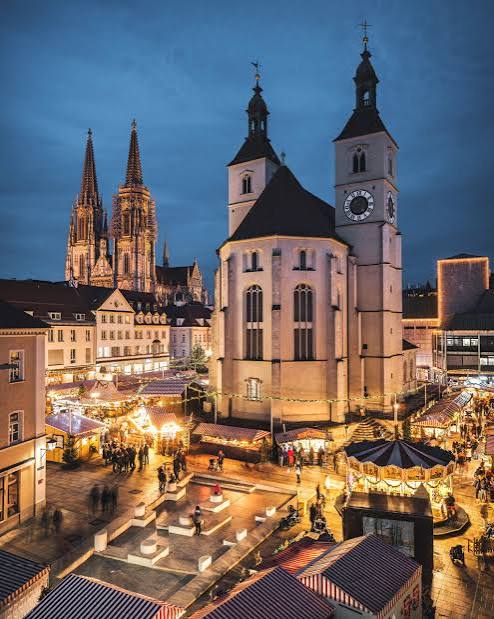
Despite regional differences, most markets share a familiar rhythm. Wooden chalets, often trimmed with pine boughs and fairy lights, sell handcrafted goods: carved nutcrackers, glass ornaments, knitted scarves, and candles. Food stalls are just as central to the experience, offering roasted chestnuts, bratwurst, raclette, and sweet treats like Stollen and Speculoos cookies.
No visit is complete without a cup of mulled wine, known by different names depending on the country: Glühwein in Germany and Austria.
Planning a Visit
Travelers hoping to experience a Christmas market should note that most open in late November and run through December 23 or 24, though a handful continue into early January. Weekday visits, particularly in the morning, tend to be less crowded than weekend evenings, when the markets draw the biggest crowds.
By river (river cruise)
- Many of the best Christmas market cities sit right on major rivers — Strasbourg, Cologne, Nuremberg, Vienna, Budapest, Passau — so a Rhine or Danube cruise can string several markets together without repacking.
- You unpack once; the ship becomes your hotel and moves overnight, so you wake up in a new city each morning.
- Docking is often close to the old town/market square, cutting down on transit time.
By land (train or car)
- More flexible — you can linger longer in a city you love, skip ones that don’t interest you, and detour to smaller, less touristy markets in villages that river ships never reach.
- Europe’s train network makes city-to-city market hopping easy (e.g., Strasbourg to Colmar to Freiburg to Basel in a matter of days).
- Generally cheaper, especially if you’re comfortable booking your own hotels and using regional trains or a rental car.
- Downside: more logistics — booking transport and lodging separately, hauling luggage between hotels, and dealing with winter road/weather delays if driving.

Rule of thumb:
- Want a relaxed, low-effort trip with beautiful river scenery and don’t mind a set schedule → river cruise.
- Want flexibility, a tighter budget, or access to smaller/hidden markets → go by land, especially by train, since many market towns are directly connected by rail.
Tip: A lot of travelers combine both — a short river cruise for 2–3 iconic cities, then a few extra days by train to explore markets off the cruise route.
To plan your Christmas Market experience, contact Anita Carson at [email protected]


