
Gadsby’s Tavern Junior Docents Build Public Speaking Skills
Visitors enjoy presentations and value the experience

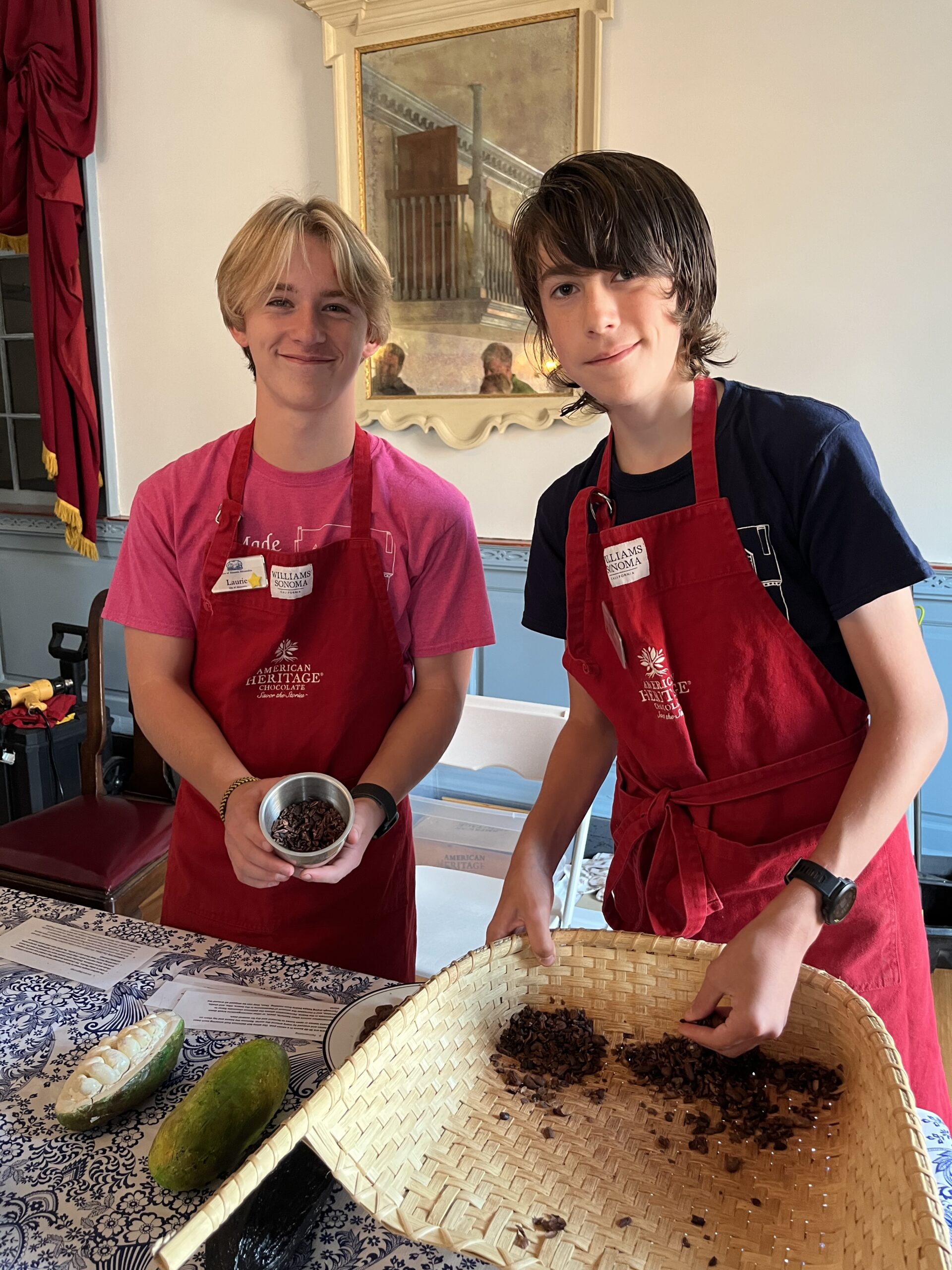
Alexandria, VA – Looking for a way to boost a child’s confidence, knowledge, and public speaking skills simultaneously?
Preteens and teenagers—known as junior docents—at the Gadsby Tavern Museum revel in the multiple skills they’ve learned just sharing information on a range of topics about the colonial days in America. To weekend visitors, hearing interesting details about business, politics, and travel energizes their experience.
A Dallas architect visiting Old Town was interested in educational historic sites and discovered that the young volunteers delivered. “I searched out local history before I came here and wanted to see 1700s architecture,” said Paul Hamilton, who also visited the Carlyle House. “I didn’t realize they had the docents—and these kids were very informative. It was a treat!”
Hamilton, the father of a 17- and a 22-year-old in Houston, observed that the junior docents gave details he will remember. “I think it’s a very educational program” he added, saying the docent volunteers certainly knew their topics. “It is better than a lecturer. We learn by interaction and experience.”
All the junior docents who talked with The Zebra couldn’t agree more that their public speaking skills and purposeful understanding of museum topics are a key part of the satisfaction of the volunteer services they provide. On Sunday, about 14 junior docents were stationed at the museum’s four floors open to the public.
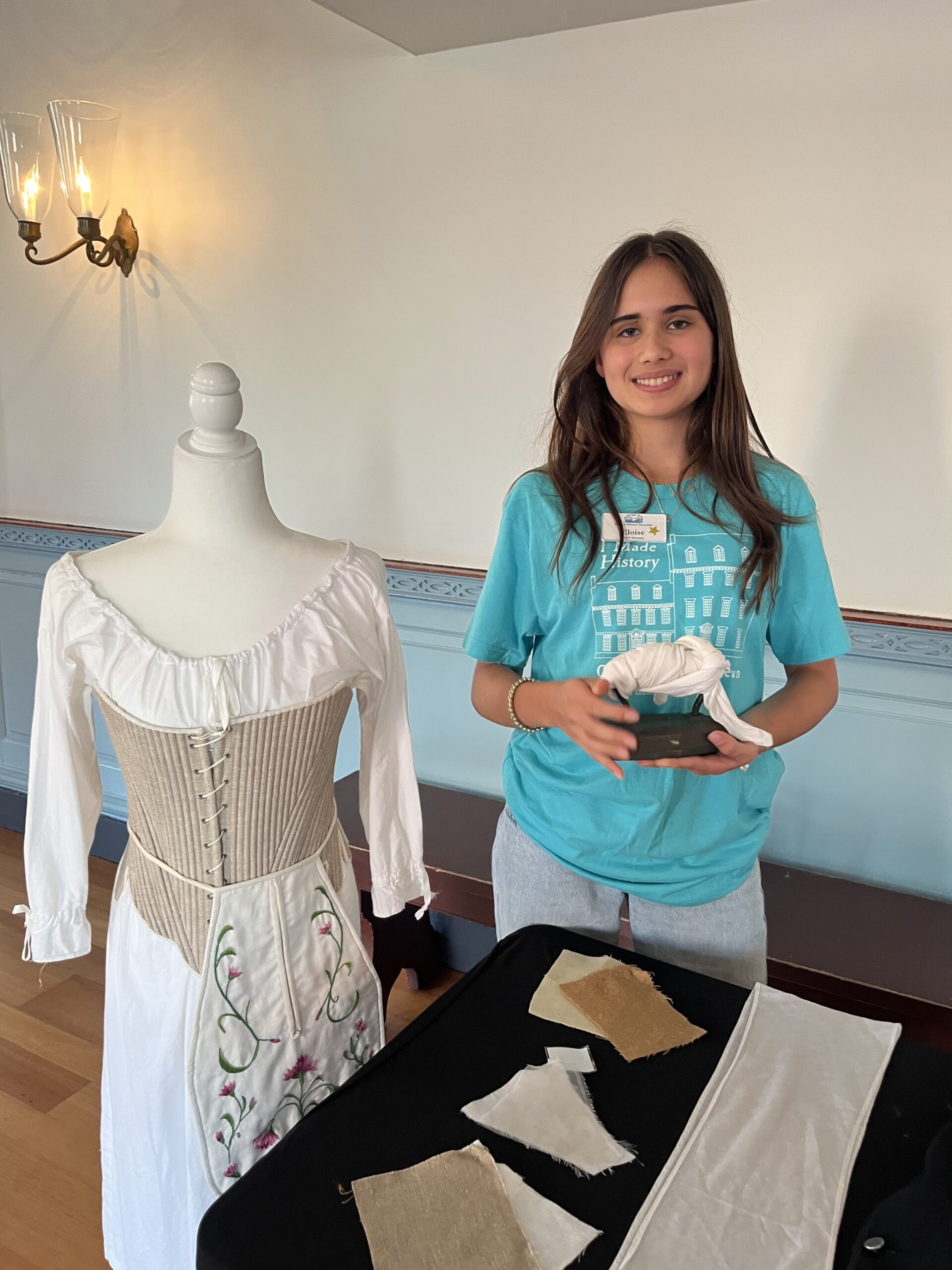
Eloise S., a rising 10th grader and a junior docent since 4th grade, said, “I really like public speaking now.” She proposed a tactile game in which visitors are invited to guess the materials used in colonial day garments. Her specialty was women’s garments, and she used a model with a colonial shift (also doubles as a nightgown, she noted) and a lace-up “stay” which “gives a stylish shape to the bodice and results in “a cone shape,” she added. “I’d like a museum docent job,” Eloise said. “I’d also like to go into marketing and do influencer events.”
Standing next to her was 6th grader Catherine T., who explained what men wore, showing a pair of black heavy cotton britches operated with a cotton string tie in an adjustable waistband (for growing boys) and a front square metal-buttoned flap.
“I love public speaking,” said Catherine, who says she has overcome her shyness and that she loves to don period dress—she was the only one doing so. “When I came here, I hated talking to people. The stranger-danger talk my parents told me really scared me. I feel like being here with a partner and talking to people have really helped. Now, all the adults love me!”
Asked about how the junior docent experience might affect a future job, she said that prior to volunteering she wanted to be an actress but now wants to be a marine biologist, adding that she is “still working on my acting skills and still auditioning for plays.”
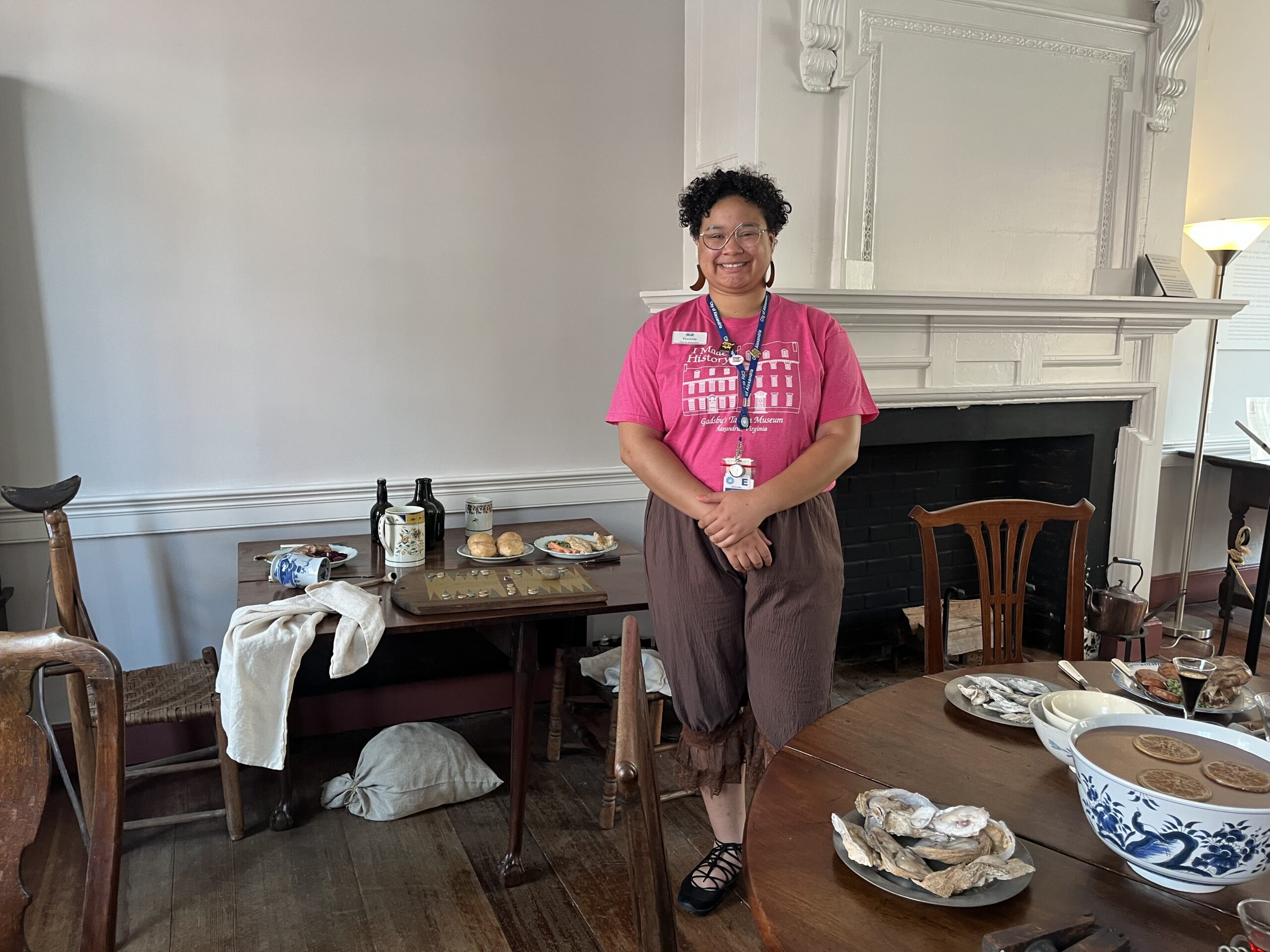
Observing the girls enjoy their interaction, Timbila Kabre, a museum educator for the Office of Historic Alexandria, said the junior docents often rotate among a few venues: Gadsby’s, the Black History Museum, The Apothecary, and The Lyceum. As a history major at Mary Washington University, Kabre understands deeply the interactive learning experience from her three years at Mount Vernon as a character interpreter playing “Ona Judge, Martha Washington’s personal maid who famously ran away from the Washingtons towards the end of George Washington’s presidency.” She said Judge escaped enslavement on May 21, 1796, a day that is celebrated in Philadelphia, where she escaped, and in Portsmouth, where she landed.
Approximately 50 junior docents were enrolled in the city’s volunteer training program, overseen by Kristy Huettner, volunteer program coordinator, with Kabre as a staff member.
“If anything, we are trying to instill professionalism and independence—giving them guidance and advice to improve their presentations—and they also connect with others who are interested in the same thing,” Kabre said.
Asked her favorite spot to interact on the Gadsby’s tour, Kabre said she enjoys the street-level public dining room, noted in history for its vibrant political discussions where colonial history’s famous travelers and leaders gathered.
“That’s where we start to talk about the systems of power in the late 18th century,” she said. “It is such a great intro to Gadsby’s. Everyone (presents) the public dining room in a different way!”


