Happy Hour Facts: 10 Things You Never Knew About the Woodrow Wilson Bridge
It carries the Beltway, crosses three jurisdictions, rises for tall ships—and has been testing Washington-area drivers since 1961.

It stops the Beltway, carries a walking trail, shelters basketball courts—and has been the scene of remarkable rescues above the Potomac.
ALEXANDRIA, VA—There is a moment on the Capital Beltway when an ordinary traffic jam becomes something much stranger.
Warning lights flash. Gates come down. Twelve lanes of Interstate traffic stop. Then two enormous pieces of roadway tilt toward the sky so a ship can pass between them.
No, you have not taken a wrong turn into a maritime theme park. The Woodrow Wilson Bridge really is a drawbridge—one carrying I-95 and I-495 across the Potomac River. When it opens, one of the East Coast’s busiest highways briefly becomes front-row seating for a very large boat.
But that is only the beginning. The bridge also offers a walk across the Potomac, hides an extraordinary recreation area underneath, touches three jurisdictions and has figured in rescue stories involving construction workers, a woman in the river and even a stranded kitten.
Here are 10 Woodrow Wilson Bridge facts worth keeping for your next happy hour.
1. Yes, a piece of the Interstate Highway System moves
The official term is a double-leaf bascule bridge. “Bascule” comes from the French word for seesaw, which is exactly the idea: two giant leaves pivot upward from opposite sides of the navigation channel.
The replacement bridge provides 70 feet of clearance—20 feet more than the original—so most boats pass underneath without stopping traffic. Tall ships, naval vessels, large workboats and certain government craft may still need an opening.
Why does the highway have to yield? Because the Potomac was a transportation route long before anyone imagined the Beltway, and the bridge must preserve the federal navigation channel. Seventy feet is generous—until a vessel needs 71.
2. You can walk or bike from Virginia to Maryland
Thousands of drivers cross the Potomac without realizing that people are walking and cycling beside them.
The paved shared-use path on the bridge connects Alexandria with National Harbor and the regional trail network. The broader Woodrow Wilson Bridge Trail runs approximately 3.5 miles from Oxon Hill Road toward Huntington Metro, with a steep half-mile climb on the Maryland side that gains about 200 feet. In Virginia, it connects with the Mount Vernon Trail.
The bridge crossing itself is roughly a mile, with wide views of the Potomac, Old Town, National Harbor and the Washington skyline. There are no garden beds growing across the bridge deck. The greenery is concentrated around the approaches, Jones Point and Rosalie Island; the elevated portion is exposed, with little shade.
It is one of the rare local outings where the soundtrack is river wind, bicycle bells and the constant rush of the Beltway.
3. The biggest surprise is underneath it
From the highway, Jones Point is something you pass over. From the ground, it is an entirely different world.
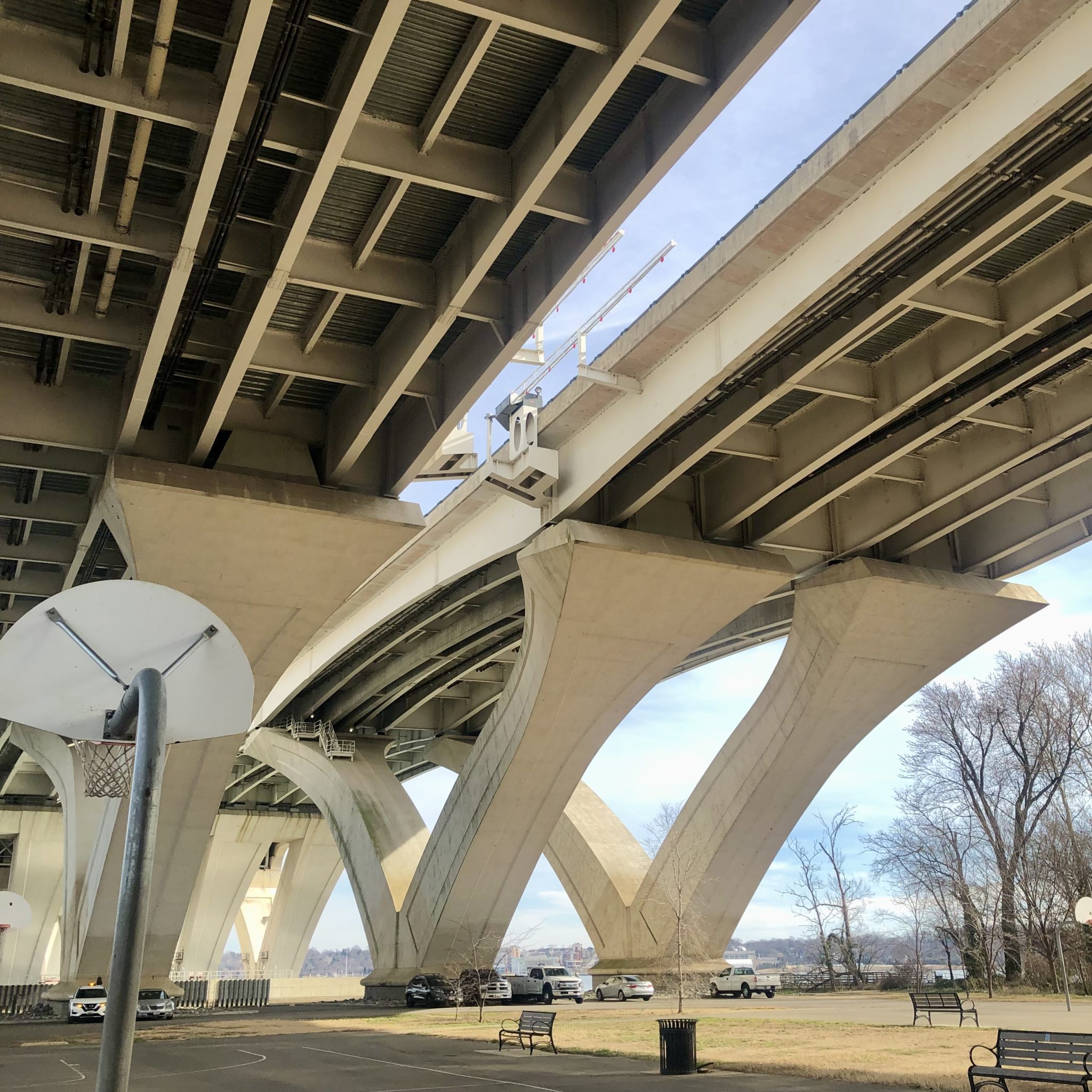
Walk beneath the bridge and the traffic becomes a steady ceiling of sound. Below it, people shoot baskets, ride bikes, walk dogs, push strollers and practice skateboard tricks in the shade of the huge V-shaped piers. Anglers head toward the river carrying rods and buckets. The Mount Vernon Trail threads straight through the scene.
The National Park Service lists two basketball courts, two playgrounds, multi-use fields, two fishing piers and a canoe and kayak launch at Jones Point Park. There are garden plots, picnic tables, restrooms and water fountains, too.
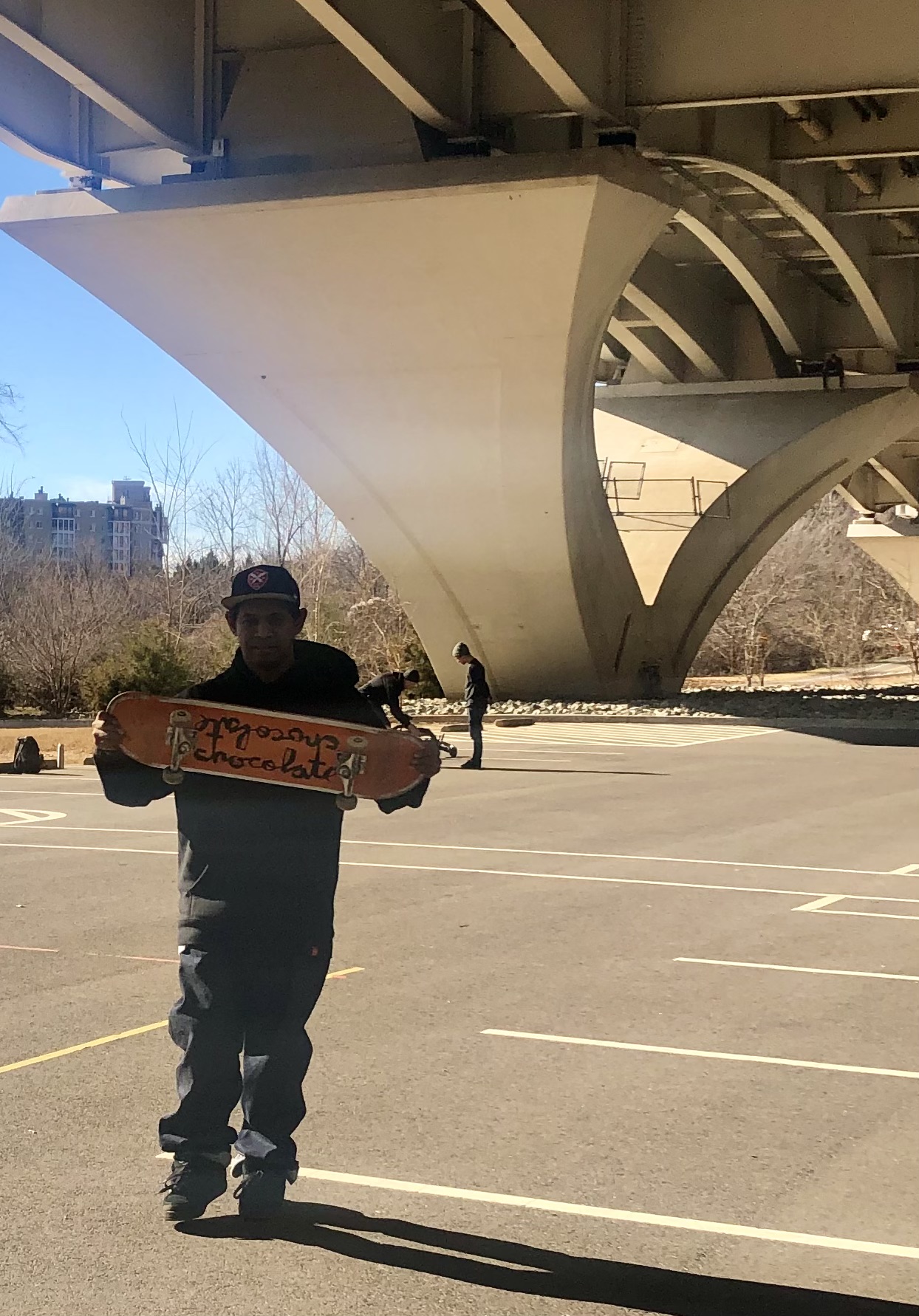
It is not an official skate park, but the broad paved area has long attracted skateboarders and rollerbladers. The concrete canopy makes the space useful when summer sun or sudden rain would end the fun almost anywhere else.
4. About 200,000 vehicles use this crossing every day
The original six-lane bridge was designed for approximately 75,000 vehicles a day. It reached that capacity within eight years.
By the 1990s, the old bridge was carrying roughly 200,000 vehicles daily—nearly three times its intended load. VDOT’s 2025 count estimates 206,000 vehicles per day on the I-95 approach immediately west of Alexandria, showing that the crossing remains one of the region’s essential transportation arteries.
The old arithmetic was merciless: an eight-lane Beltway squeezed into six lanes at the river. Every bridge opening added another layer of frustration. The replacement consists of two parallel six-lane spans with full shoulders and separate local and through lanes.
5. One bridge touches three jurisdictions
Here is the trivia-night answer people are tempted to challenge: the Woodrow Wilson Bridge touches Virginia, Maryland and Washington, D.C.
The western end reaches Alexandria. Most of the crossing lies in Maryland. A small portion passes over the southern tip of the District. That geography made the original bridge a bureaucratic curiosity: the federal government owned it while Virginia, Maryland and the District shared operating and maintenance responsibilities. Maryland and Virginia jointly own the replacement spans.
6. It almost had a much more local name
The planned crossing was originally called the Jones Point Bridge. Congress renamed it for Woodrow Wilson in 1956, partly because the former president had signed the Federal Aid Road Act of 1916 and was known to enjoy long automobile rides.
Construction began in 1958, and the bridge opened on Dec. 28, 1961—the 105th anniversary of Wilson’s birth.
That dedication came with a remarkable footnote. Edith Bolling Wilson, the former president’s widow, had been expected to unveil the plaque. She was too ill to attend and died later that night at age 89. Wilson’s son-in-law represented her at the ceremony.


7. The replacement came in under budget
Planning for the new bridge began in 1989 and evolved into a long regional argument involving transportation agencies, courts, preservationists and nearby residents. Alexandria challenged the environmental review, raising concerns about Jones Point Park, historic resources, nearby cemeteries and the scale of placing a 12-lane crossing beside Old Town.
Construction began in 2000. The first new span opened in 2006 and the second in 2008. The larger project rebuilt approximately 7.5 miles of the Beltway and four interchanges between Telegraph Road and Indian Head Highway.
The price tag was approximately $2.5 billion—and according to the Office of Historic Alexandria, the project finished $86 million under budget. A Beltway megaproject coming in under budget may be the most unbelievable fact in this entire story.
8. The bridge has been the setting for extraordinary rescues
The Wilson Bridge is not officially known as a “suicide bridge,” and available records do not support giving it that label. People have jumped from it, however, and police and marine units have carried out rescues.
In March 2026, a Prince George’s County police officer entered the Potomac after a woman jumped from the bridge. The officer held her above water until a marine unit arrived, and she survived.
Another rescue unfolded in June 2018 after a truck collision caused an explosion and fire. Three construction workers were left trapped in a work bucket dangling beneath the bridge. Prince George’s County Police marine officers positioned their boat directly below the workers while smoke filled the air and burning diesel fuel fell toward them. Fairfax County firefighters lowered the workers into the police boat one by one.
Then there was the kitten.
In July 2026, witnesses reported that someone had tried to throw a kitten from a moving vehicle on the bridge. The frightened animal became stranded outside the roadway railing. An officer calmly coaxed it back to safety, and the kitten was recovered without injury.
There does not appear to be a single authoritative public count of every Wilson Bridge rescue, so attaching a grand total would be misleading. These documented cases tell the story better: the bridge has repeatedly put police officers, firefighters, marine crews and ordinary witnesses in situations where seconds mattered.
If you or someone you know is in crisis, call or text the 988 Suicide & Crisis Lifeline.
9. Pieces of the old bridge are now home to fish
When crews dismantled the original bridge, 65,000 tons of cleaned concrete did not go to a landfill. It went into the water.
Over two years, 52 barge loads of bridge material were used to create five artificial reefs in the Chesapeake Bay and Potomac River. One reef grew to approximately the size of two football fields. Divers soon found striped bass, bluefish, mussels, barnacles and oysters colonizing the structures.
Somewhere beneath the Chesapeake, fish are now swimming through the remains of a bridge that once carried nearly 200,000 commuters a day.
10. You can make an afternoon of exploring it
Jones Point Park is the best Alexandria starting point. The park is open daily from 6 a.m. to 10 p.m. Visitors can walk beneath the bridge, see the basketball courts and playgrounds, follow the Mount Vernon Trail, fish from the piers, visit the 1855 Jones Point Lighthouse and search for the original 1791 boundary stone marking the beginning of the federal district.
To cross the bridge on foot or bicycle, follow the shared-use trail east toward National Harbor. Bring water and sun protection; the elevated crossing is exposed. Watch for expansion joints and dips, and remember that the Maryland approach includes a substantial climb.
Stand beneath the bridge for a few minutes and it stops feeling like infrastructure imposed on a park. It becomes the park’s ceiling—enormous, noisy and strangely beautiful.
And the next time traffic suddenly stops overhead, you will know why: somewhere ahead, a piece of the Interstate Highway System may be rising into the sky while the Potomac takes its turn.
Your Wilson Bridge Happy-Hour Takeaway
The bridge opens for tall vessels, carries roughly 200,000 vehicles a day, touches three jurisdictions, offers a trail across the Potomac, shelters an entire recreation area—and part of the original bridge now lives underwater as five artificial reefs.
Zebra Bridge Watch
When the Wilson Bridge goes up, we let you know. Follow The Zebra Press and subscribe to our newsletter for future opening notices, safe viewing tips and the stories behind Alexandria’s most surprising bridge.


