

Alexandria, VA – When I was young, I loved to pretend. I listened to Let’s Pretend on the radio. From the 1930s to the mid-50s, Let’s Pretend was one of the most highly praised radio programs for children. Growing up in the 40s, I didn’t know that. I just liked it enough to tune in every Saturday morning.
We didn’t have a television set then. Although TV was commercially available, only a few of the families in our 112-unit apartment building had one, and we kids would migrate to those who did. I liked radio more than television. I preferred imagining what characters looked like.
There were two books of fairy tales in the house – Grimm’s Fairy Tales and Fairy Tales by Hans Christian Andersen. They were old and worn even when I was a kid. They were like friends and I wish I could see them again.
Grimm’s fairy tales were folk stories collected by brothers Jacob and Wilhelm Grimm. The stories, first published 1812-15, were gathered from oral traditions and old books to preserve German folklore and history.
I didn’t identify with many characters. I didn’t have long golden hair and had not been gifted with an ethereal voice like Rapunzel. In the Cinderella story, the king ordered a three-day festival to which all the beautiful young women were invited so that his son might choose a bride from among them. Even as a kid, the emphasis on beauty didn’t seem right to me.
I preferred the tales by Danish writer and poet Hans Christian Andersen, especially The Ugly Duckling. I too felt like I didn’t fit and wanted very much to one day become a swan. Andersen also authored The Emperor’s New Clothes. I wanted to be the brave kid who told the emperor he had no clothes on.
As I was drafting this column my attention was drawn to a headline in a Zebra post that reported Stephen Colbert was honored a few years ago by the Virginia Theological Seminary in Alexandria – not as a writer of fairy tales, but as a truth-telling storyteller. (Search “Colbert” on thezebra.org for the story.)
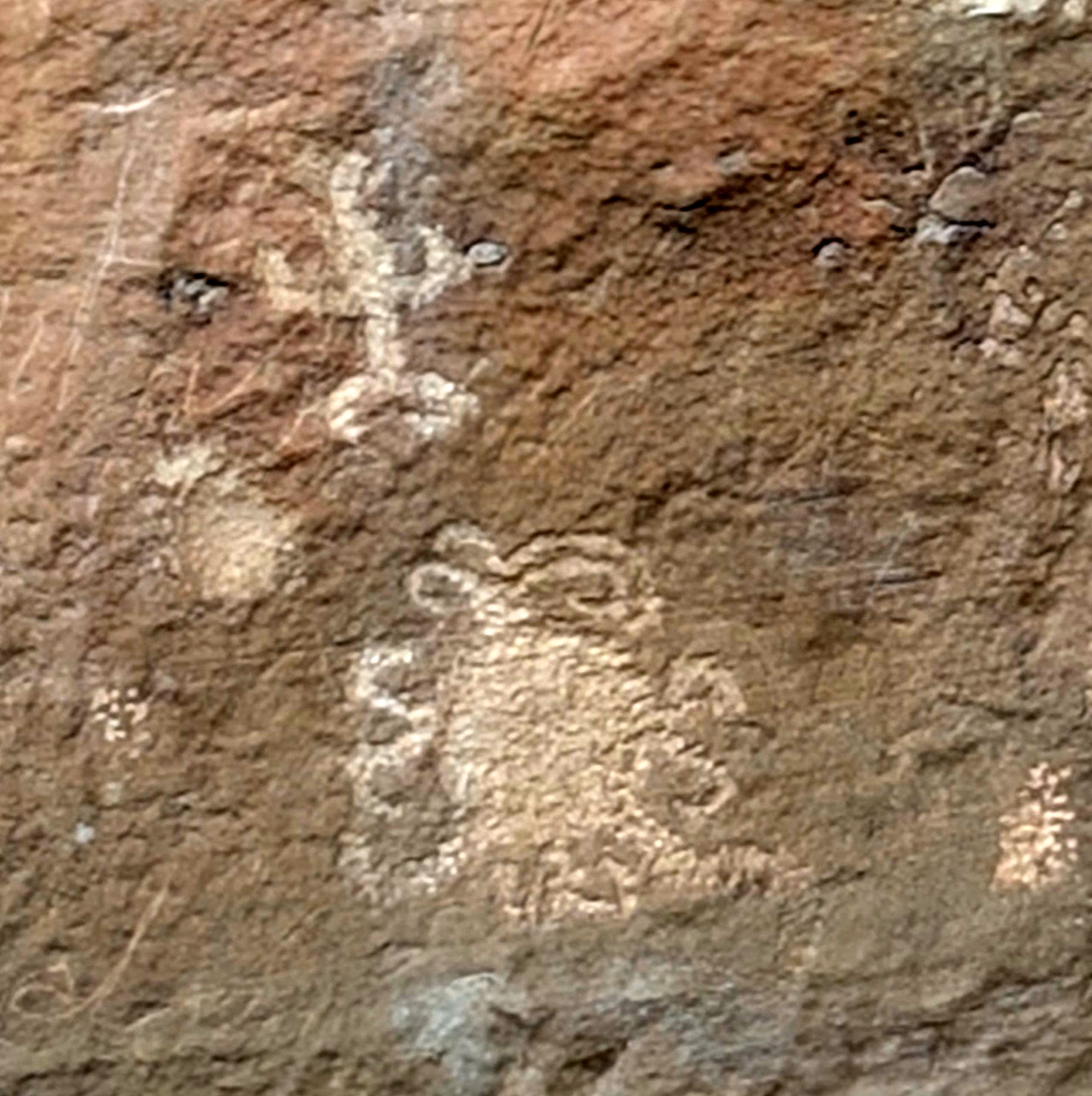
Storytelling goes back a very long way. Before written language, early humans not only told stories around the fire, they told them in pictures. Paintings on rocks and in caves portray animals, daily life, and important happenings. First-born daughter Julie recently shared a photo from a Road Scholar tour that was thought possibly to show a solar eclipse. (https://www.livescience.com/60129-ancient-rock-art-depicts-solar-eclipse.html)
I asked Julie what she felt when she saw them. “The sense of wonder in the things we see, and the need to record them, forces humans to create the tools. We find the paint and the surface even if it means using rocks and stones,” Julie mused.
Did those early people learn not to look at the sun? I wonder. Other animals are known to communicate but I think we are the only creatures to use pictures. Later, we learned to write down our stories. I love these words on the magic of books by astronomer Carl Sagan, born in 1934 in my hometown of Brooklyn, New York:
“When our genes could not store all the information necessary for survival, we slowly invented brains. But then the time came, perhaps ten thousand years ago, when we needed to know more than could conveniently be contained in brains. So we learned to stockpile enormous quantities of information outside our bodies. We are the only species on the planet, so far as we know, to have invented a communal memory stored neither in our genes nor in our brains. The warehouse of that memory is called the library… Writing is perhaps the greatest of human inventions, binding together people, citizens of distant epochs who never knew one another. Books break the shackles of time, proof that humans can work magic.”
For some 30 years I was a professional photographer. I told stories with pictures. My photographs were a way of tugging at your sleeve and saying, “Oh, stop and look, see what I see.”
I think the early humans were doing the same thing. We are kin.
Mosaic artist/photographer Nina Tisara is founder of Living Legends of Alexandria.


