
Checkpoint Charlie: A Cold War Memoir of Freedom and Divided Berlin

Alexandria, VA – “Freedom is indivisible, and when one man is enslaved, all are not free. When all are free, then we can look forward to that day when this city will be joined as one and this country and this great Continent of Europe in a peaceful and hopeful globe… All free men, wherever they may live, are citizens of Berlin, and, therefore, as a free man, I take pride in the words ‘Ich bin ein Berliner.’”
~ President John F. Kennedy, June 24, 1963
I was 11 and living in Germany, a mere 60 miles from the East German border. It was a grand time – a hardy time – a heavy time to be an American. We were living what historians later dubbed “the American Century.”
My father was Tank Company Commander in the 3rd Armored Division. It was the late fall of 1965 and my parents, my sister, and I took a night train to Berlin to visit our family friends, then-Captain James “Jim” Shelton and family. Jim was serving in the Berlin Brigade – the eyes, ears, and vanguard of defense of western Europe against the armies of the Soviet bloc.
The train only traveled at night from the free West through the East Zone into the island of what was then called West Berlin. The East was controlled by an authoritarian government put in place by the then-Soviet Union (Russia). We had to surrender our passports when we boarded the train and all blinds had to be drawn closed during our transit, even at night.
Just before dawn the train stopped in the town of Potsdam, a suburb of Berlin. Being an inquisitive kid, I slyly peaked under the curtain and looked out. The steam exhausted from the train and blew a mist across the platform. Rising out of the mist were several East German soldiers, clad in calf-length greatcoats, Russian-styled winter hats, and carrying machine guns.
The Shelton clan met us at the Bahnhof and whisked us to their quarters for a whirlwind week of tours and events.
One evening the parents took off for a night of 1960s partying – dinner, dancing, and a floorshow at a cabaret. On their giddy ride home, Jim maneuvering the dimly lit streets, my father asked him if it was easy to get lost and wind up in the East Zone. Jim slammed on the brakes and spun the car around. Without explanation he raced the car several hundred yards and said, “Stan, it’s that easy.”
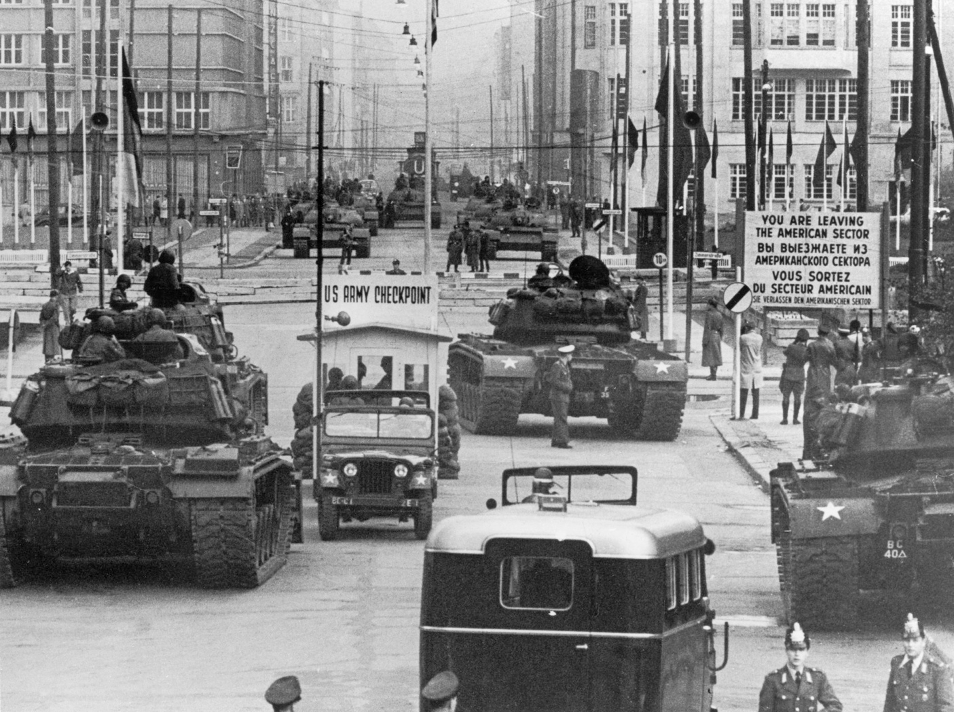
A few days later my mother, Dee Dee, and I went on a tour of West and East Berlin. My father held a security clearance, so he could not come along. After an interesting tour of West Berlin, the bus stopped about 100 yards from Checkpoint Charlie and our jovial, dashing, and funny tour guide went to the door and announced, “Now, in a few minutes they will board the bus. They will ask you for your passports. Show them. They will ask you to show your Military Dependent I.D. cards. Show them only your passports – nothing else.”
Then he said to three young, enlisted U.S. Army soldiers in uniform sitting in the back of the bus, “They will ask you for your passports and I.D. cards. SHOW THEM NOTHING. Sit up, look straight ahead, and say nothing. Under international treaty your uniform is your passport.” He left the bus.

Minutes later, after driving through a maze of cinderblock, barbed wire, and mines in No Man’s Land, the East German guards boarded, machine guns pointed at us. An officer examined our passports with his drawn pistol, studied our faces, and then they all retired.
The East Berlin side of the tour revealed a dour, gray, and dismal city. Public buildings were still scarred with cannon and small arms bullet holes 20 years after the end of World War II. The Reichstag building was a skeleton, the market plaza had only 15 people, and we only saw two cars the entire day.
Returning to the West, we stopped at Checkpoint Charlie, disembarked, and mounted a tall reviewing platform where you could see the Berlin Wall, the minefield, and into the East.
It is a memory that would stick with me for decades.
So, this month as we mark our 250th anniversary as a young nation – as you barbeque, hoist a beverage, set off fireworks, buy that 4th of July Sale car, or see your favorite band at a concert – remember that dictators come in all shapes, sizes, lifestyles, sectors of the economy, and creeds.
Remember that democracy is fragile and, like a flower, can fade away if not nurtured.
Most important, remember: Freedom is not Free.


