
Ray Greenstreet Is Still Here – and Telling His Story
A year after nearly losing his life, the Greenstreet Gardens owner has written a deeply personal memoir - and discovered how many others were waiting for permission to talk.
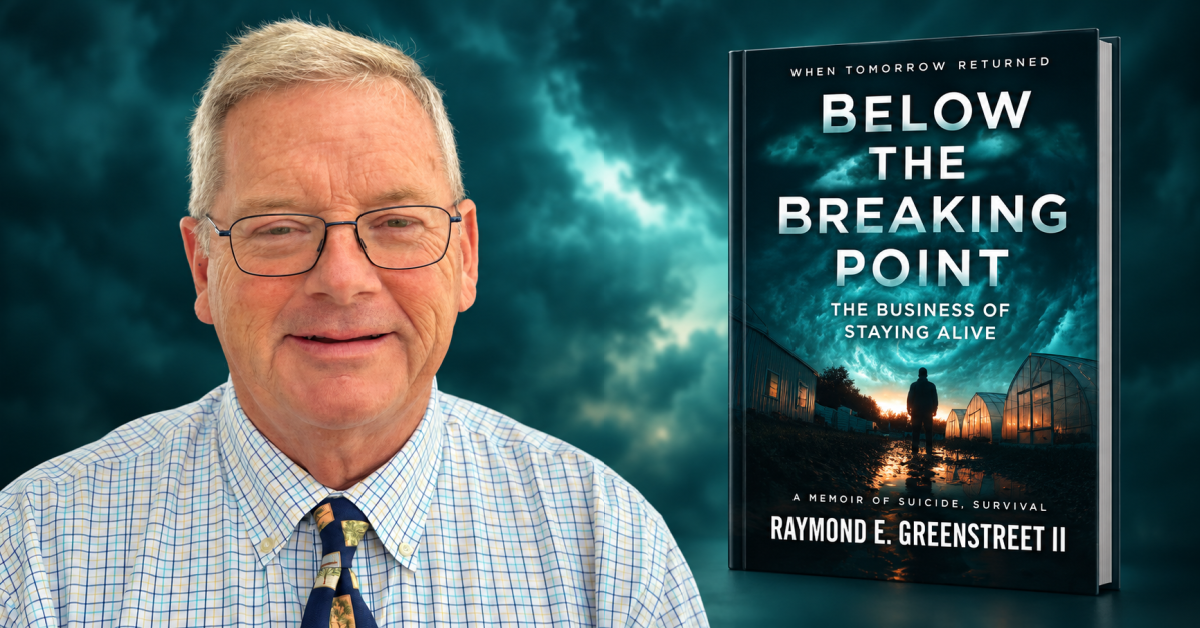
ALEXANDRIA, VA—Last week, Ray Greenstreet was driving with a Greenstreet Gardens employee he is training for a new position when she brought up an anniversary he knew was coming.
It had been almost a year since Greenstreet nearly died by suicide.
The employee, who speaks limited English, had some questions about what happened and what Greenstreet had been thinking. Then she told him something he wasn’t expecting.
“We want to have a party in the greenhouse,” she said.
Greenstreet didn’t quite know what to make of that. A party? For this?
She explained: “But you’re still here.”
The simplicity of it caught him.
“Oh, well, I think that’s kind of cool,” Greenstreet recalled.
Then came the very Ray Greenstreet solution to how one celebrates an anniversary he never imagined celebrating.
“So, I think Friday I’m going to buy pizzas.”
Greenstreet is the longtime owner of Greenstreet Gardens, with a retail nursery on West Braddock Road in Alexandria and the company’s flagship nursery and growing operation in Lothian, Maryland. He is a husband, father, farmer, businessman and familiar figure in the communities where he has spent decades growing plants, building a business and building relationships.
And the people who work with him wanted to celebrate one simple fact: Ray was still there.
A year ago, Greenstreet himself could not see his life that way.
Now he is telling the story of how close he came to losing it.
His 242-page memoir, Below the Breaking Point: The Business of Staying Alive, published in June, is an intensely personal account of the financial fear, pressure and distorted thinking that led a successful businessman surrounded by family, friends, employees and community to believe his death could somehow solve the problems he thought he had created.
Greenstreet never expected to write a book.
“Never, ever, never, ever even thought about being an author,” he said. “It’s not anywhere on my bucket list.”
Today, the book is generating speaking invitations from churches, business organizations, schools and others. Greenstreet has spoken about mental health at Cultivate, the horticulture industry’s major trade show in Columbus, and said he has received invitations from high schools and the University of Maryland. Luminis Health has also asked him to serve in a patient-advocacy role and participate in a mental-health discussion.
Maryland Public Television spent hours with Greenstreet this spring filming a segment expected to air later this year about mental health and farmers.
Greenstreet welcomes the opportunities, but he is careful about his role.
“I’m not a therapist. I’m not a doctor,” he said. “When I talk about all this, I’m talking about my story.”
A Journal and a Rubber Pen
The book began in a crisis unit.
“They give you not much,” Greenstreet recalled, “but they give you a journal and a rubber pen that you can hardly write with.”
He kept the journal.
At home, he began typing thoughts on his laptop. Ideas would come in the shower or while walking his dog, Gunner, and he would try to hold onto them until he could get home and write.
The chapters came “all over the place,” he said, and changed repeatedly as he pieced them together.
The process forced him to revisit not only what he had experienced, but what his wife, Stacy, and their children—Ryan, Seth and Abigail—had gone through.
“It really made you walk back through and look at it, kind of looking through the window,” Greenstreet said. “And I learned a lot about myself and I learned a lot about Stacy and people and everything else.”
Stacy is considerably more private than her husband.
“Stacy let me write because she’s much more private than I am,” he said. “I think she just felt like, as my recovery, my journey, I really needed to be able to put that out there.”
She read the manuscript more than once.
“It was very hard for her,” Greenstreet said. “She’s been very supportive of it.”
Greenstreet is also clear that his suicide attempt was not the result of trouble in their marriage. His crisis grew out of financial fear and increasingly distorted thinking.
Today, Ray and Stacy attend couples therapy together—something the man who once “never believed in therapy” now views very differently.
“I feel our relationship is really probably the best that it’s ever been,” he said.

The “101st Option”
Perhaps the most unsettling discovery Greenstreet made was that the idea of suicide had not suddenly appeared during his crisis.
It had existed somewhere in his thinking for as long as he could remember.
In the book, he calls it the “101st option.”
“That has been in my brain for as long as I can remember,” Greenstreet said. “So to me, it was just normal.”
He remembers telling Stacy that he had carried that option “in my back pocket forever.”
She asked why he had never told her or asked for help.
“Because in my mind, there was nothing wrong with it,” he said. “It was normal.”
That answer is one reason Greenstreet believes talking about mental health matters so much.
“We avoid mental health so much as a conversation,” he said. “You don’t have a chance to know really what is maybe normal and what’s not normal.”
For him, one lesson towers over the others.
“It’s the silence,” Greenstreet said. “That’s the most deadly thing, at least for me it was. Not sharing or communicating.”
“I Just Listen”
Since Below the Breaking Point was published, people have been telling Greenstreet things.
Mothers have reached out about sons who attempted suicide or are struggling. Men who say they do not read have read his book cover to cover.
“I had one guy say, ‘I haven’t read a book since seventh grade,’” Greenstreet said.
More striking are the encounters that happen when Greenstreet is simply out in public.
“I would say almost daily when I go out in public, somebody comes up and shares their story,” he said.
They include friends, business leaders and public officials. Someone will ask whether he has a minute or offer to walk him to his car—and then tell him something deeply personal.
“It’s like they had this thing inside,” Greenstreet said.
He doesn’t try to fix it.
“I don’t offer any advice,” he said. “I just listen.”
Then he said something that may explain the response to his book better than any review could.
“It’s almost like I gave them permission to talk about this.”
A Different Perspective
Greenstreet can trace some of his own thinking back decades.
His father worked in automobile fleet sales, where some years were good and others were difficult. Greenstreet remembers what financial uncertainty did to his family.
“I learned at a young age that I didn’t want that to happen to me,” he said.
He became a worker, planner and problem-solver.
“You just pick stuff up,” he said, “and you keep putting it in your bag, take care of it.”
Greenstreet describes himself as a perfectionist and workaholic. Those traits helped him build a successful business, but they could become unforgiving when something went wrong.
“People are going to know I failed,” he said of the fear that once drove him. “That’s the biggest fear.”
His daughter Abigail recently reminded him how deeply the push-through-it philosophy had shaped him.
She read his book, something Greenstreet had not been sure she would ever do. Later, she told him she was proud of what he was doing to help people with mental health.
Then she reminded him of what he used to tell her when she struggled.
“Dad, when I was struggling with mental health, all you said was, ‘Put your pants on, put your shoes on, go.’”
Greenstreet understood.
“You know, that’s all I knew,” he said.
Now?
“Now I have a different perspective.”
That perspective extends to strangers.
“I’m trying to be a kinder person out in the world,” Greenstreet said.
He thinks about the cashier at the grocery store or the server in a restaurant.
“I also realized that everybody’s got [something],” he said. “And you just don’t know what somebody is struggling with.”
So he tries to offer a kind word or genuine compliment.
“Just that little kind word,” he said. “I’ve seen it really work.”
Keeping His Feet in Today
Greenstreet does not describe recovery as something that simply ends.
“My brain still goes sideways on things,” he said.
The difference is that now he recognizes it.
“I know that it’s happening,” he said. “And then I try to do something to slow it down or stop it or take a breath.”
He might walk outside, work on cars or talk to Stacy—even if they are not discussing exactly what is going through his head.
His mornings have changed, too.
“It’s a daily struggle,” he said. “I get up, I make my bed, I say my prayer. I walk with Gunner. There’s certain things that I do every day.”

Before his suicide attempt, he said, “I used to come out of the bed like a rocket.”
He could wake at 3 a.m. thinking about banks, drivers, crops and all the decisions ahead.
“All I could think about is all the things I had to do,” he said.
Some future thinking comes with farming. Growers are always planning months ahead. But Greenstreet realizes now that he had stopped inhabiting the present.
“I was living so far in the future,” he said. “My two feet weren’t in today.”
“I Shouldn’t Be Here”
Greenstreet does not want his suicide attempt to become his identity.
“I don’t want to be defined by this,” he said. “This is part of my journey to life.”
He remains the person he was before it happened.
“I’m still a farmer. I’m still a greenhouse guy. I’m still a community person,” he said. “It’s just something else that I’ve added to my deck of cards.”
But he also believes surviving has given him something important to do.
Asked whether he now feels there is a place for him to use what happened to help others, his answer came immediately.
“One hundred percent.”
“I shouldn’t be here,” Greenstreet said. “I shouldn’t have survived it. And something kept me here.”
He credits the hospital with saving his life, but believes there was something more.
“I think I came out of it with a clear mind,” he said.
During September, Suicide Prevention Month, Ray and Stacy plan to participate in a suicide-prevention walk in Annapolis. Greenstreet has also signed up for a 30-mile dog-walking challenge benefiting suicide prevention.
And he wants people to know he is willing to speak—to churches, schools, businesses, industry groups and others who believe hearing his story could help start a conversation.
A year ago, Greenstreet could not see what his wife, his children, his friends, his employees and his community would lose if he were gone.
Last week, a greenhouse employee put it much more simply.
They wanted to have a party.
Because he was still there.
Greenstreet thought about that.
And then he decided to order pizzas.
About the Book
Below the Breaking Point: The Business of Staying Alive is Raymond Greenstreet II’s 242-page first-person account of his suicide attempt and the financial fear, pressure and distorted thinking that preceded it.
Greenstreet wrote the memoir for people who may themselves be struggling, but also for families and friends trying to understand what someone they love is experiencing.
“I wrote the book for people that are in trouble, people that have family in trouble,” Greenstreet said, “but also wrote it for my family, my extended family and the community to try to give them really a fresh look of what happened.”
Below the Breaking Point: The Business of Staying Alive is available on Amazon.
If you or someone you know is in crisis, call or text 988 to reach the Suicide & Crisis Lifeline.


