
Historic Preservation in Alexandria: Protecting Douglass Cemetery and City Landmarks

By Daniel Lee
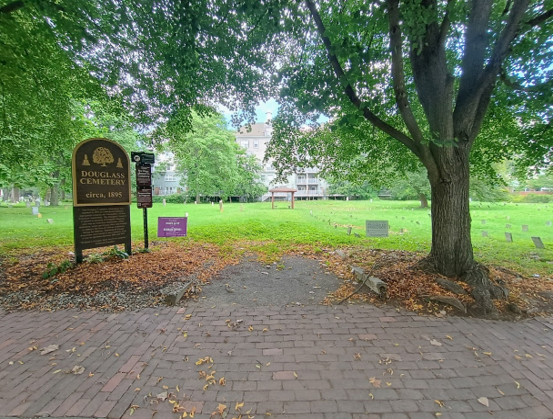
Alexandria, VA – National Preservation Month started as National Preservation Week in 1973. In 2005, the National Trust expanded the celebration from a week to the entire month of May to explore a fuller exploration of buildings and spaces of historical significance. This year, Historic Alexandria highlights its work preserving the Douglass Memorial Cemetery.
The Douglass Cemetery Association established Douglass Memorial in 1895 at 1421 Wilkes Street. The Association named the cemetery after Frederick Douglass. The western half of the cemetery was used first and was divided into family lots, allowing relatives to be buried together. The eastern half of the cemetery shows a chronological pattern of burials. Records suggest over 2,000 people were buried at Douglass. Today, only 605 individual gravestones, footstones, corner markers, and other fixtures are identified and recorded.
The City of Alexandria committed itself to the preservation of Douglass Cemetery in partnership with the Social Responsibility Group and the Friends of Douglass Cemetery. Residents and City staff have identified multiple issues that threaten the preservation of the cemetery, including areas of standing water, the condition of the burial markers, and drainage. The preservation efforts have required patience, given the complexity of the challenges and the sensitive nature of the historic site, including unmarked burials.

Long before the designation of National Preservation Week, historic preservation was a priority in Alexandria. Alexandria has the third-oldest designated district in the nation, behind only Charleston and New Orleans. The Old and Historic District was designated in 1946. Historically African American Uptown was designated as the Parker-Gray Historic District in 1984. The establishment of both the Alexandria Archaeological Commission in 1975 and the Archaeological Resource Protection Code in 1989 made Alexandria the first of its kind nationally.
Alexandria’s initial love of historic preservation focused on buildings, not cemeteries. A major driver for historic preservation in Alexandria was the 1976 Bicentennial Celebration. Some of the buildings restored for the commemoration were The Lyceum, Carlyle House, and the two buildings that compose Gadsby’s Tavern Museum. After serving until the late nineteenth century as a tavern and hotel, these two buildings were used for a variety of commercial uses and fell into disrepair. In 1929, American Legion Post 24 purchased the buildings, saving them from demolition. In 1972, the buildings were given to the City of Alexandria, restored, and reopened for the 1976 Bicentennial Celebration. Today, visitors can tour the historic rooms of both buildings, which have been restored to their eighteenth-century appearance. Archaeological excavation, paint analysis, and documentary research have provided an accurate picture of the furnishings and use of the buildings during the period 1785 to 1808.

This May, residents and visitors can take advantage of unique opportunities to further Alexandria’s legacy of Historic Preservation. We hope you will join us!
Readers can learn more about Historic Preservation at https://www.alexandriava.gov/Preservation
To learn more about Douglass Cemetery, please visit https://www.alexandriava.gov/historic-sites/douglass-memorial-cemetery.


